
Techniques
Tips for Neurodivergent Knitters
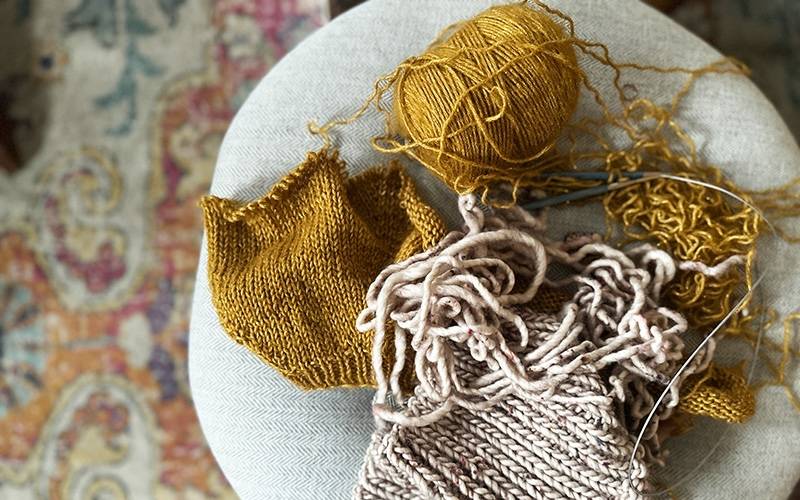
About three years ago, I was diagnosed with ADHD with dyscalculia.
Suddenly, my life made sense. My brain works differently, yes, but both ADHD and dyscalculia were impacting the one thing I never thought it would: knitting.
I find knitting to be a meditative, relaxing practice. Imagine my frustration when I realized my stitch counts were off or that I was making repetitive mistakes people might consider careless. For me, those moments are a sign of when and where I lost focus.
So I put my needles down and started to think about how I can help myself continue being a knitter. Below are some mindset shifts, novelty, structure, and stimulation—that help me enjoy the process.
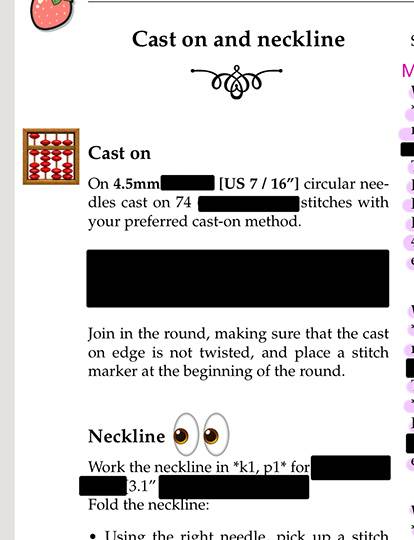
My patterns are redacted. Dana shared this tip with me because I’m constantly fighting a battle between distraction and focus, especially when I’m reading. I bring all of my patterns into my Noteshelf app and block out everything that doesn’t pertain to the size I’m making. I also block out steps that I have completed. Do my patterns look crazy? Yes—but this fix probably helped me the most.
I added an emoji key to hack my patterns. ADHD brains are wired for novelty so I developed an emoji key to mark up my patterns. I can’t explain how much joy this brings to my brain.
Frog and pivot ASAP. Recently I frogged a raglan sweater because I felt like I was always counting or avoiding counting. So I pivoted and selected a new pattern. When I cast on, it immediately felt like there were fewer numbers to keep track of and less stress on my working memory. Suddenly, I was having more fun.
Measuring is easier than tracking rows. Give me a pattern that says “knit until the yoke measures 3 inches” rather than “repeat these rows 30 more times” any day.
“Beginner” doesn’t mean “easy.” Sometimes my brain needs a more advanced pattern than my skill set warrants. My brain can get distracted if I’m not engaged, so I try to find patterns that challenge me and hold my focus longer.
I buy or make cute notions for a boost of dopamine. Knitting is even more fun with silly accessories. Doughnut stitch stoppers! I ordered them in bulk. Day of the Week undies stitch marker set! I’ll take two please. And I make my own stitch markers sometimes. Dressing up my projects with these notions makes me smile and fires up my neurotransmitters when they are a little low.
Even as a newish knitter, I don’t swatch for everything. Sometimes I need a project I can just jump into, like the Sophie Scarf or, most recently, a cute beanie I saw on Instagram. If I swatch for these projects, I will quickly lose interest, so I just jump in. After those smaller projects are done, I check my gauge. They become wearable swatches.
But I love swatching for sweaters even though I rarely get gauge right away. This is my favorite ADHD-informed mindset shift. Recently, when I didn’t get gauge, I didn’t get frustrated. Instead, I made a list of projects that I like that met the gauge I got with my yarn. Most of them were already in my Ravelry faves. This shift helped me create a list of projects that are ready to knit today.
I use the Ravit App instead of Ravelry. I’ve been on Ravelry since 2012, when I was crocheting. I love Ravelry—but the web and mobile interface overwhelms me with all the visual noise and information. Ravit connects to my Ravelry account, aligns better with how my brain works, and organizes everything in a cleaner way.
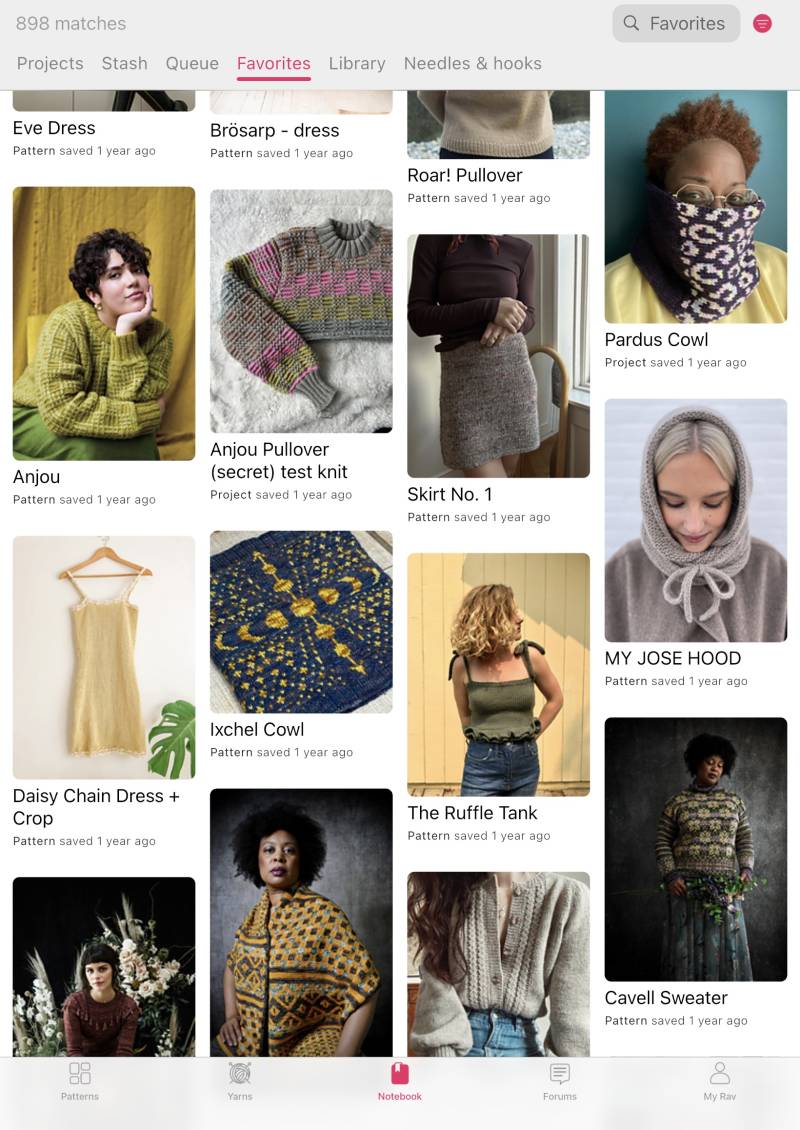
Ravit App Screenshot
Knit nights are body-doubling sessions. The Cleveland Clinic states that “Body doubling means you’re doing a task or project while in the presence of one (or more) people. In turn, that person serves as an anchor to help encourage focus, accountability, and productivity.” When I’m struggling to focus on a particular knitting project (a.k.a. I’m bored but I want to finish it), I take it to my knit night. This is especially helpful when I’m on sleeve island.
Neurodivergence affects every part of my life. Understanding that knitting patterns are not necessarily written with neurodivergent brains in mind, I can make adjustments to “right” the patterns for my brain so I can continue to enjoy the knitting process.
Notice that I said process; I’m probably still working on the sweater you saw me with three months ago. However, I am as comfortable with my knitting project output not being huge as I am with being a continental knitter. It is these ADHD adjustments that help me enjoy the practice of knitting every time I pick up my needles.
Editors’ note: PS Going to Vogue Knitting Live? We are—come join us! We’ll be at an Irish pub called Connolly’s (Times Square location just one block from the Marriott!) from 4-6 p.m. on Friday, January 30. What could be cozier than that? Let us know you’ll be there—reply here.

Interesting and informative- This was great! I’m not neurodivergent but the redacting idea is absolutely brilliant. I’m trying this right away because circling the numbers I need sometimes just doesn’t work based on how the pattern is formatted and what font is used.
Yes! Redacting is a brilliant idea for aging eyes too. I think it will help tremendously when looking from my knitting to my iPad.
Will also check out your other suggestions. Thank you!!!
Wow! Jessica, thank you so much for this. I have ADHD, and even though I have apparently had it for many years, I’m just now (I’m 75) learning how much it affects me, and working out ways to adapt. I will save and reread your post; your tips ring bells for me!
You must be so inspiring for anyone else with your diagnosis or in fact anyone whose brain is different in any way. In fact we are probably all different in something or other that challenges us and your example says don’t give up, find a way to work with it or through it. It is also fascinating to others how you have, in a way, tricked your brain to make it do what you want it to. So with more meaning than usual, Jessica, I say “Happy Knitting!”
Thank you for this!!!
Thank you Jessica! How refreshing to consider your ideas (even though neurodivergent is a new term for me). I regret I won’t be at VKL this year. Would love to meet you!
I love the redacting idea! I’ve been knitting for some 50+ years and this never occurred to me. BRILLIANT!
Wonderful, helpful post Jessica! 70 yrs young and just figuring out ADHD. Glad to know these tips now.
One of the biggest helps for neurodivergent folks is learning what helps and processes work best for them. It can take a lot of trial and error, and of course one person’s solution may not be yours. But sharing these ideas and tips is very helpful for those who are still working through the process.
This is wonderful information, I’m sending to my knitting partner. This describes my friend exactly, constantly frustrated with her knitting, can’t keep focused, mistakes and lots of unknitting. I hope this article will be helpful for her.
I’ve always highlighted information for my size in patterns. I love seeing the colors, but I think I might try redacting now. Even though I am not neurodivergent, there are definitely benefits to having more focus. And THANK YOU for the tip about the Ravit app. It is definitely an improvement for mobile viewing of Ravelry!
THANK YOU, JESSICA!! These tips are such a wondrous gift to me
In 2012, I fell backwards down a flight of steps, sustaining a severe closed head injury. My life turned on a dime that day.
My knitting was never the same.
Now I have some tools to ease the stress of my knitting.
W O W
Wow! SO MUCH good stuff in this post! These could be a big, big help! Thank you.
Yes to all of these — especially redacting patterns. There is so much visual clutter and extra information in most patterns. I like to print mine and highlight the size I need to cut down on distraction and make it easier to follow what I actually need to do next. (And Ravit >>> Ravelry, IMO!)
Wonderful article. I’m not neurodivergent, but I don’t like visual clutter. The Ravit app is such a great option – thank you for bringing it to my attention.
I think we all have ways of dealing with knitting gone wrong. You gave helpful tips we all can use.
Thank you for the things you do to help you continue knitting. I find a few of these suggestions would be helpful to me too especially the redacting. Knit on!!
Jessica,
I am so glad you wrote this article as it gives me useful suggestions for my ADHD family members who have some of the same issues.
Many blessings for your knitting life. Nancy
Thank you for this information. I have been knitting since I was ten years old. I am now 78. Several years ago I was diagnosed with ADHD. I was very surprised but I realized I fit all the markers for this diagnosis. Lately I have noticed I am having trouble with my knitting. Patterns seem harder to read and my brain refuses to pick up the simple task of certain knitting patterns.
After reading this article, I found some advice that I think will help the problem.
Thank you for bringing this to my attention.
Jessica…ditto on all the comments regarding your suggestions and for sharing your challenges and successes!
I am fascinated by the body doubling concept…so true! Just never knew if had a label!
Also am so ordering the days of the week panties…but going to try to get the whole 7 days instead of 5…my brain isn’t happy with an incomplete set 🙂
Great post – thank you! Undiagnosed adhd here but have my own few tips to help me “concentrate/succeed”.
Firstly I upload the pattern to AI and ask for just the instructions/pattern set out in clear lines. Sometime with a tick box to help if there’s space.
I also print the pattern so I’m not tempted by distraction on my iPad.
If there are a few increases within say an 8 row repeat – I’ll make a little chart and work out how many stitches I should have at the end of each row and make myself check it. That way I’ll find out quickly if I’ve gone wrong somewhere. In the past if I’ve realised I’ve made mistakes a while back, I often put down the project and never pick it up again.
This is SO helpful. Thank you
Loved reading about how you’ve analyzed what works for you and how to make adjustments so that you can keep on creating at your own unique pace in your own unique style. Lot’s of wonderful tips to try! Thanks!
I am not neurodivergent that I know of, but I am old, and that does things to my brain. Hacks like redacting patterns are very helpful. I prefer paper patterns, so I can put them up on the pattern stand my husband made for me (especially the charts for lace or sock patterns). What I’ve learned to do is highlight all the stitch counts to do with my size, but blocking out instructions that are strictly for other sizes is a great idea. Maybe I need to use electronic versions of the instructions along with paper charts. I would also keep written pattern instructions for those times when reading charts is confusing – yes, there is one pattern I did recently where the only way I could get through was via the written instructions.
The more I learn about neurodivergents, the more I think I may be one, too. Thank you for your wonderful tips. I can see how they can help me with my knitting as well.
Great article. Really helpful. Thank you for sharing this useful information.
I’ve been highlighting my size on printed patterns but I’m switching TODAY to redacting–Sharpie-ing out the useless (for me) information.
The redacting idea seems useful to so many of us. I wanted to note that the Tin Can Knits app allows one to see just the numbers in the pattern for the size and weight of yarn one is using. Very helpful for their patterns which come in many sizes and yarn choices.
WOW! Thank you! You’ve done a fantastic job of explaining how to adjust and modify the knitting process for those many of us with ADD, ADHD, and dyscalculia. I’m 74 and wasn’t properly diagnosed until I was in my 50s. I have never been able to clearly explain why my knitting, that I love, can get easily off track and is so slow.
Thank you for this! I am a neurodivergent too and the things you described here are spot on for me too. I thought it was because I was a new knitter. I appreciate you sharing your adjustments as these are things I would like to try as well to be less frustrated while knitting.
I love your insights here – thank you for sharing!!
Hi! Thanks for sharing your experiences. I’m neurodivergent, too. I don’t redact my patterns, but I do go through them with a highlighter marker marking the bits that are relevant to the size I’m knitting. I also have lots of projects on the go. Every project has its own bag. Each one in a different room in the house ready for knitting action.
I really enjoyed your comments. You gave me some good tips. Anytime we do a task with someone else, it is always more enjoyable. I just might join a knitting group.
Thank you!
Would you tell us which of Dana’s lovely pieces has something about redacting patterns?
Dana and I are bffs, and we were chatting when she made that suggestion to me.
What an insightful and fun article. Great topic and useful tips!
All of your comments and additional tips have made my day!! I’m still learning and making adjustments and I’m so glad this resonated with so many of you.
Everything about this post is “don’t complain, make it work!” What others might call obstacles, Jessica sees as things to exploit or pivot from to a new & better place. I’m not neurodivergent (so far as I know) but I am inspired by this post to start looking at life differently. Thanks!
This was an excellent article. I am not neurodivergent, but I think it’s important for all of us to understand that different people may think or process information differently. Over the years I’ve taught Knitting and needlepoint classes, and it has always been important to adapt how I provide information to each student in a format that is understandable to them.
That is me to a T. Thank you, thank you, thank you for this article. I have switched to crocheting because it allows me to change the patterns more easily. I am so NOT making things with knitting other than quick scarves and hats. It is just too painful. I generally start off with a pattern that has a lot of stitch changes some of which I need to learn. I love textured patterns and have recently learned the joy of using very chunky quick to come together yarn. Then as I get bored I switch colors or stitches. I like to think of it as creating something new, that’s all mine! I celebrate big time when I actually finish a project and there are many to finish. I will be redacting!