
Letter from Paris
Such Stuff as Dreams Are Made On
Dear friends,
Looking back, 2025 was a banger of a year for fashion and textile exhibitions in Paris. I wrote to you about some of them, including “Louvre Couture” at the Louvre and “Worth” at the Petit Palais.
Those were blockbusters with immense crowds. “Louvre Couture” pulled in more than a million spectators, making it the second- most-attended temporary exhibition in the history of the museum.
But there were also excellent smaller shows in lesser-known spaces, and this week I walked up to Montmartre for one that’s continuing until July 31, 2026: “L’Etoffe des rêves (the stuff of dreams).”
In the exhibition title, etoffe carries a dual meaning of “stuff” and “fabric.” This is a group show of contemporary textile art by several dozen artists, with an emphasis on what is often called “outsider art” in English (in French, art brut). Outsider artists tend to avoid (or be excluded from) the networks of the mainstream art world, are often (though not always) self-taught, and frequently make use of unconventional and/or recycled materials.
La Halle Saint-Pierre: Hidden in Plain Sight
“L’Etoffe des rêves” occupies two levels in La Halle Saint-Pierre on the Rue Ronsard, a former covered market converted into a vibrant community creative space with a café and bookshop.
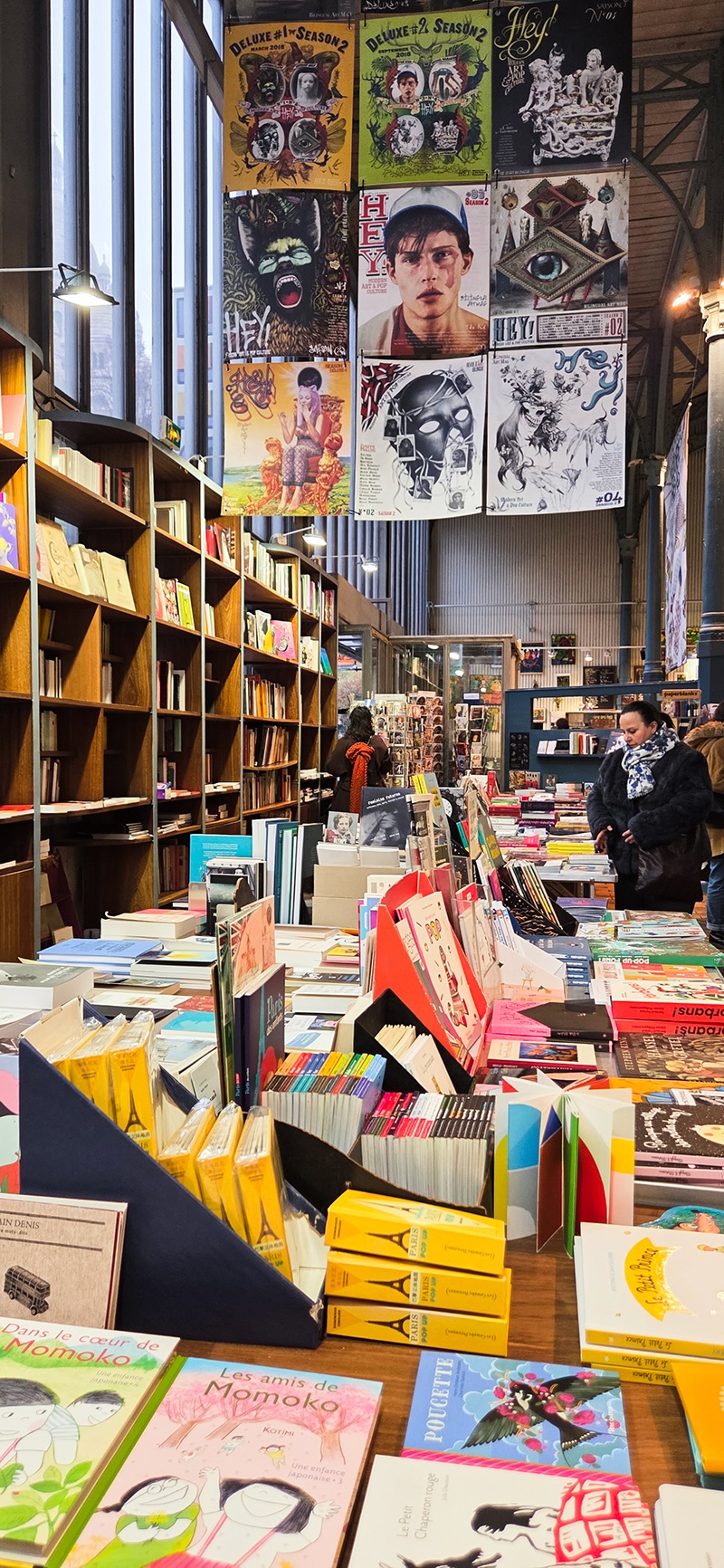
The bookshop at La Halle Saint-Pierre
It feels, miraculously, like a well-kept secret for locals despite sitting at the foot of one of the most heavily trampled tourist sights in Paris: the Butte de Montmartre, crowned by the Basilique du Sacré-Coeur.
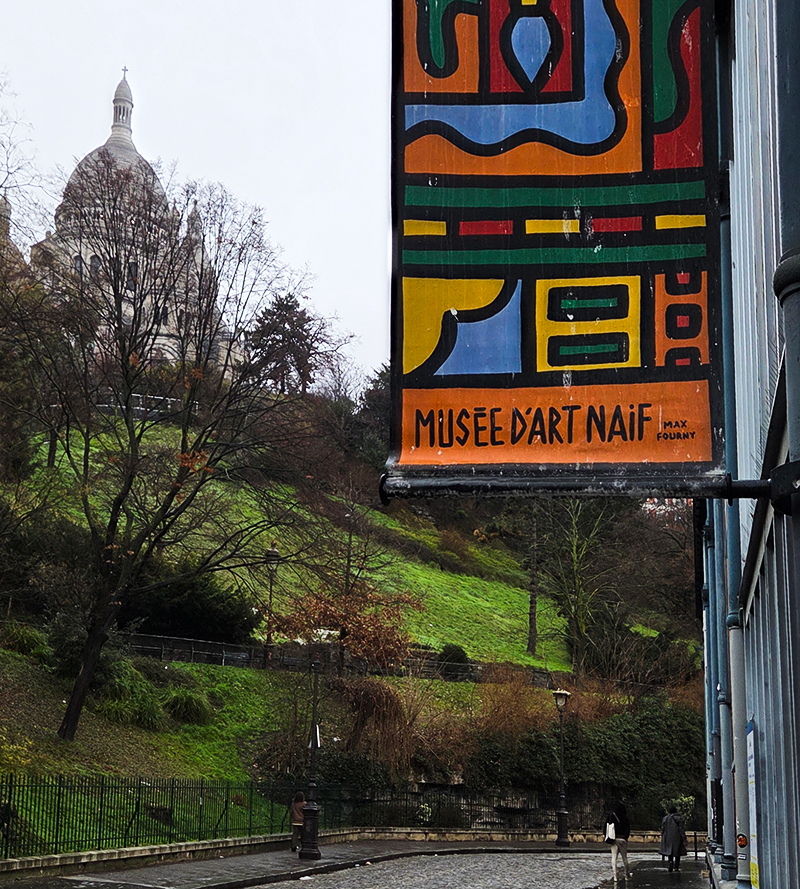
La Halle Saint-Pierre, the Butte, and Sacré-Coeur
The surrounding streets are full of sewing shops—this is where I do most of my fabric shopping—which makes it an even more fitting showcase for textile art.
So What’s This Show About?
The exhibition statement says (I translate),
Historically linked to the decorative arts or domestic practicality, textiles have established themselves as objects of artistic reappropriation and embodiments of culture and community. Thus they raise questions about gender, the borders between art and craft, and the status of textile artifacts in relation to ornamentation, writing, or architecture, to the point of becoming a favorite medium for poetic escapism.
Well, okay then.
In summary, this means that the artists have chosen to express their ideas using fabric, thread, yarn, and/or tools and equipment related to them; and that this choice brings with it a whole bunch of other historic and cultural associations.
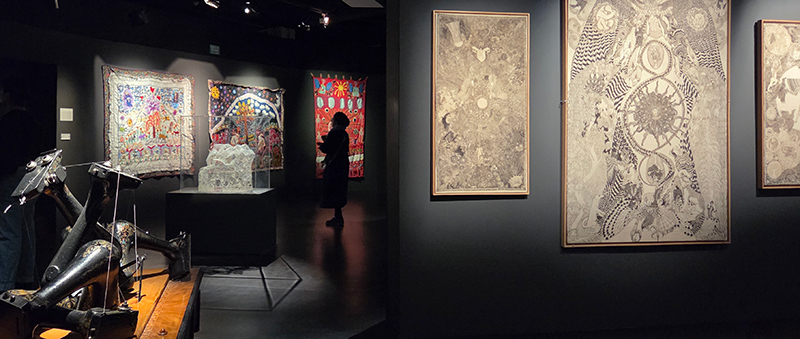
The pieces range from small and delicate, like Marie-Rose Lortet’s Le livre de neige (the book of snow)…
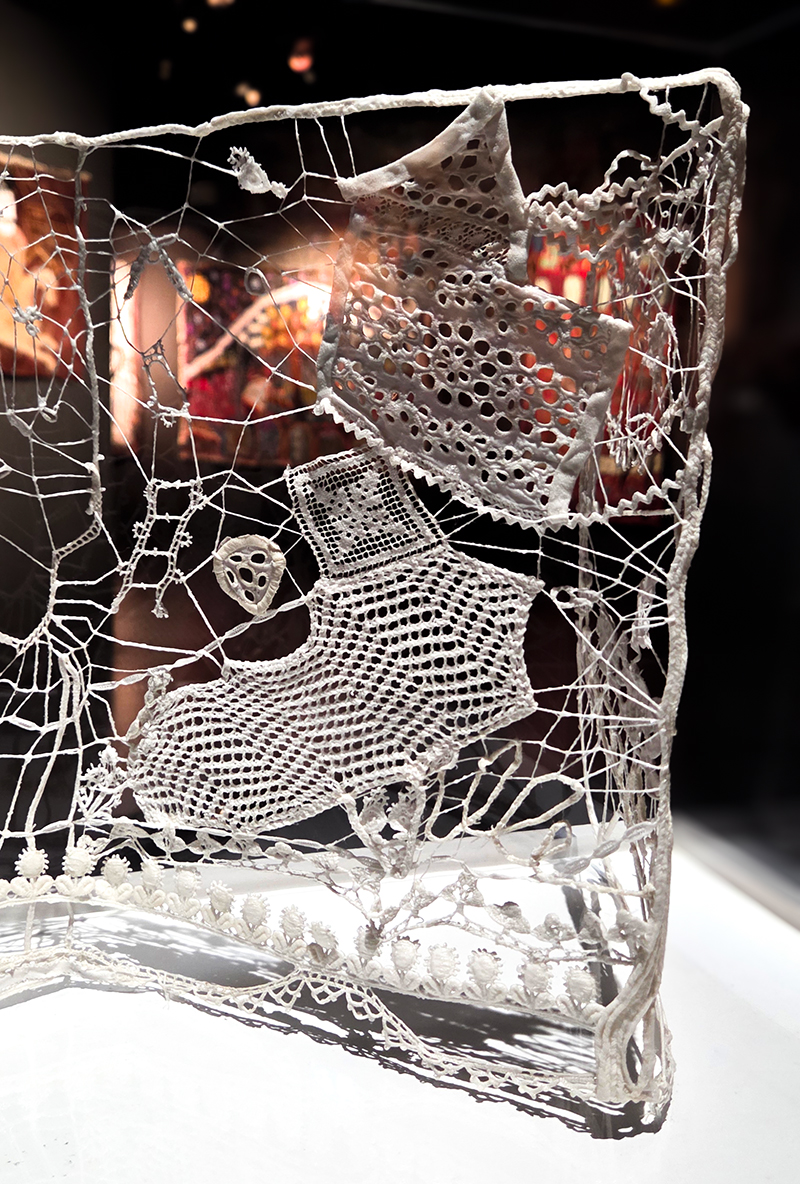
Marie-Rose Lortet, Le livre de neige (2013), detail
…to room-sized installations, like Hervé Bohnert’s startling upholstered crypt.
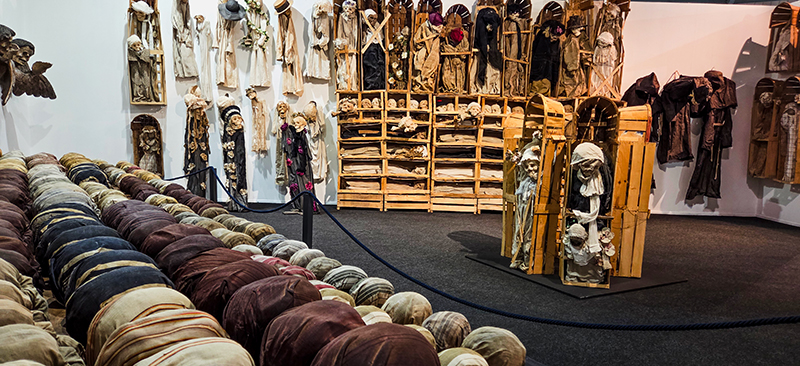
Hervé Bohnert, Installation
Of course I couldn’t possibly begin to describe everything in a letter, so I won’t try. The best I can do is show you some of what struck me the hardest, and tell you what it made me think about.
Women’s Work
Not all the artists in “L’Etoffe des rêves” are women–but most of them are.
It’s impossible to walk through the galleries and not think about how much of what you see is traditionally (you might also say stereotypically) identified with women and women’s lives. I don’t mean only the use of embroidery, sewing, knitting, and so forth…
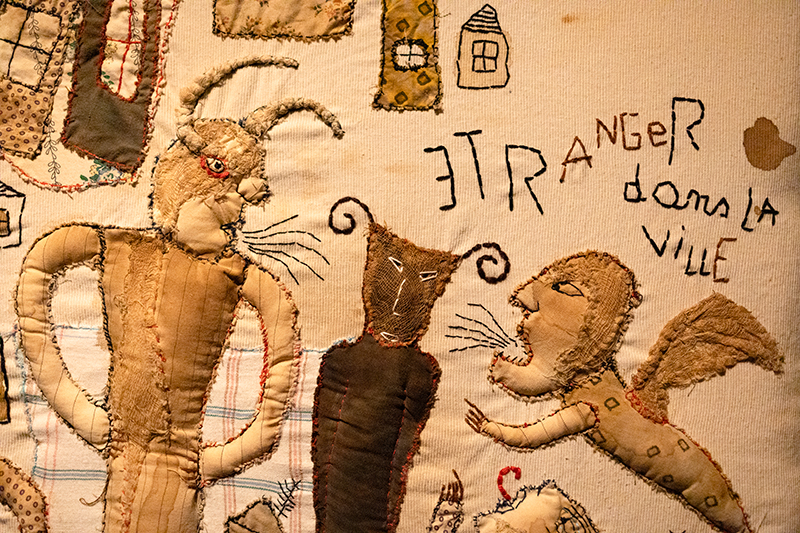
Barbara d’Antuono, Étranger dans la ville (2017), detail
…but also the forms they take, including clothing, quilts, blankets, keepsake boxes, and many, many, dolls from miniature to life-sized and beyond.
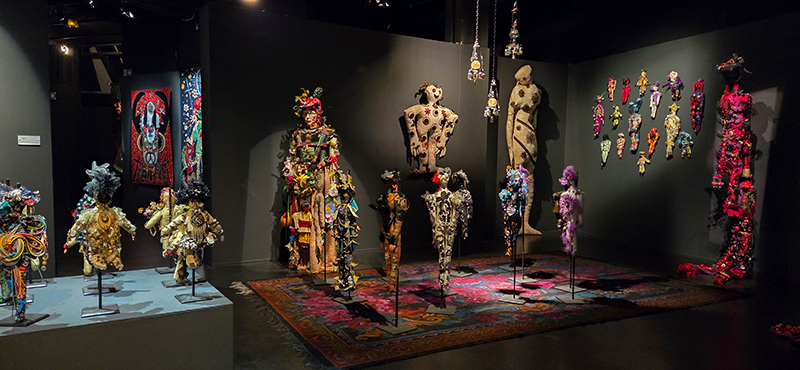
Works by Josette Rispal
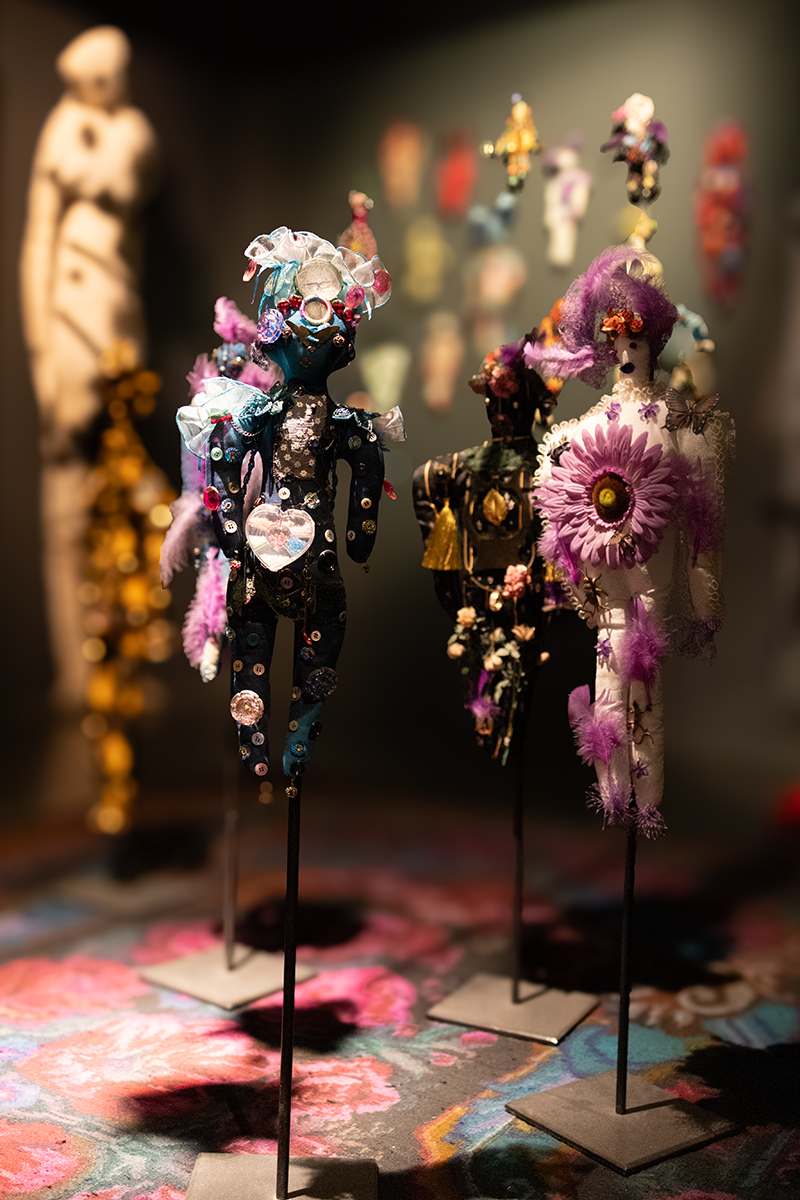
Josette Rispal, Les Chiffonettes
Making Do
The use of found, leftover, and recycled materials in art has a long history. At the moment it is very à la mode, the choice of the artist who wants to include the words “eco” or “engaged” in the program notes.
In the context of “L’Etoffe des rêves,” I kept thinking of how often women who have wanted to express their creativity have been forced to use odds, ends, and remainders for lack of other resources.
I thought of my mother and grandmother, who sewed new clothes first for their children, next for their husbands, and then–if there was still time–for themselves, using what was left. This is often idealized in historical narratives as “thrift,” usually without acknowledging that thrift often arises not from virtue but from deprivation.
Marion Oster’s astonishing series of large hangings depicting quasi-religious and mythological figures transforms the miscellaneous into the majestic.
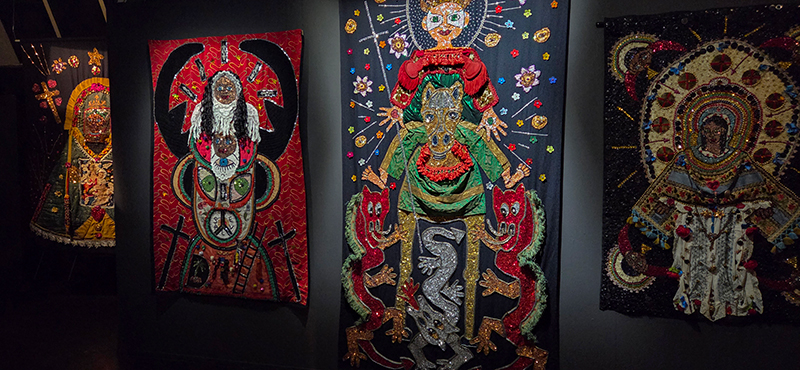
Hangings by Marion Oster
At first sight, pieces like her Mère à l’enfant (mother and child) have the glittering, hieratic presence of Byzantine mosaics.
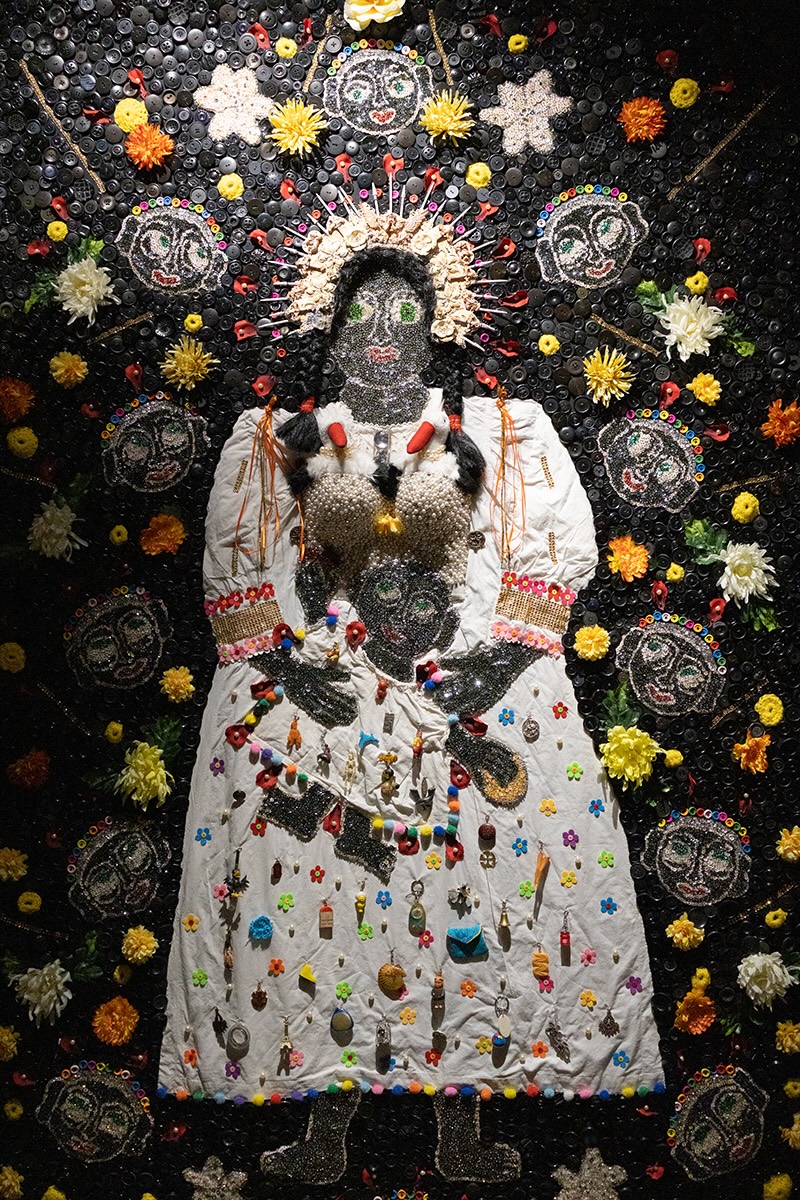
Marion Oster, Mère à l’enfant
As you approach, you find that this is the result of the masterful arrangement of unlikely, low-rent materials like mismatched buttons, fileted stuffed animals, cast-off bits of trim, and novelty plastic key chains.
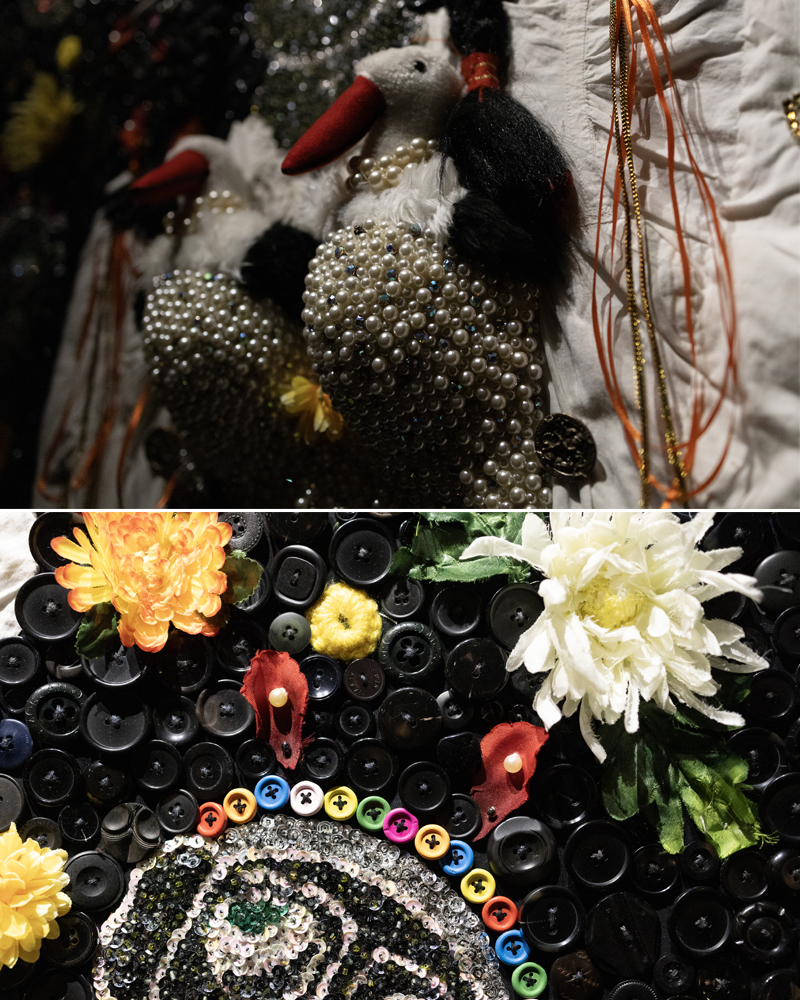
Marion Oster, Mère à l’enfant (details)
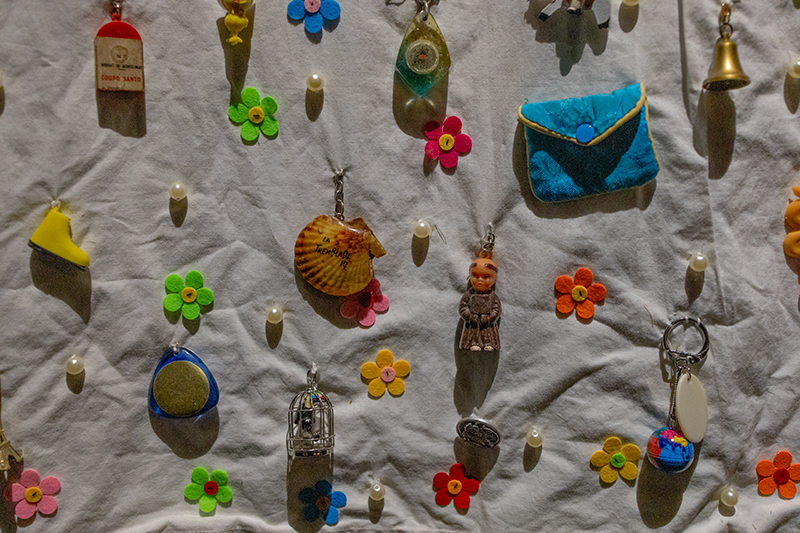
Marion Oster, Mère à l’enfant (detail)
Aurélia Jaubert contributes what look like two monumental tapestries–one of the few forms of textile work universally acknowledged as fine art.
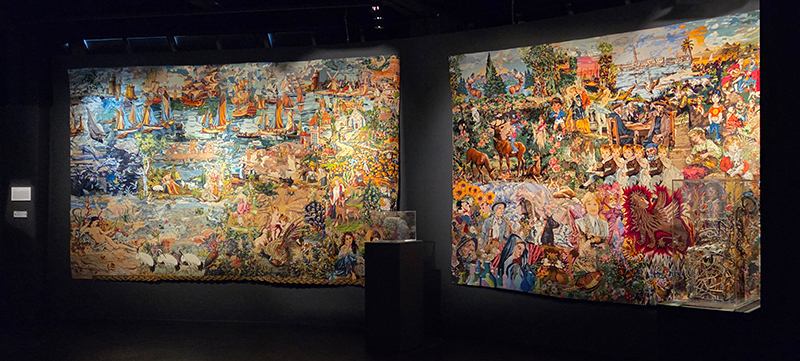
Aurélia Jaubert, Ici Harold a navigué sur la mer (2021) and Collection Grand Maîtres (2020)
Look closer, and you see that she has stitched them together from amateur needlepoint canvases. The sort of handwork that often ends up discarded, donated to charity shops, or consigned to the attic. Together, these anonymous works of earnest kitsch achieve a dignified second life.
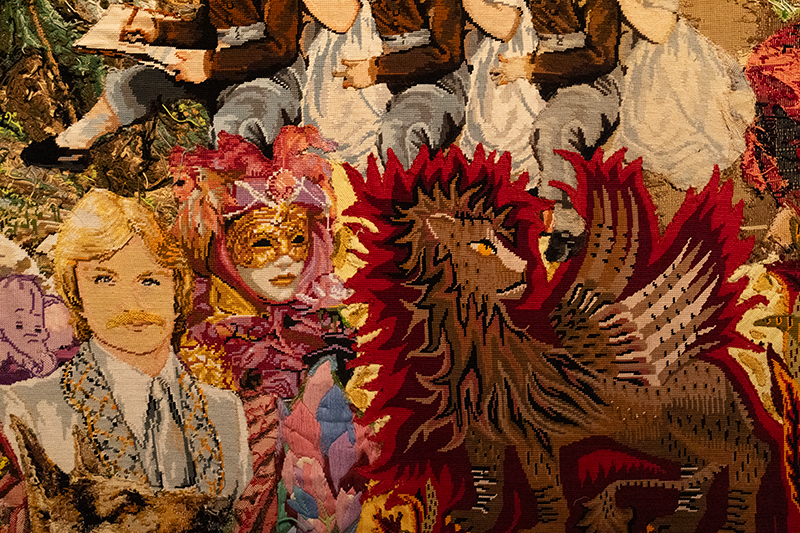
Aurélia Jubert, detail from Collection Grand Maîtres
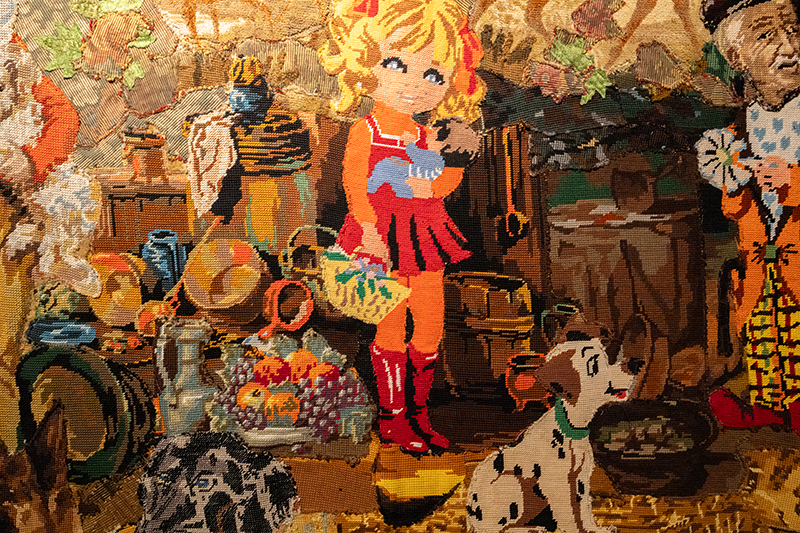
Aurélia Jubert, detail from Collection Grand Maîtres
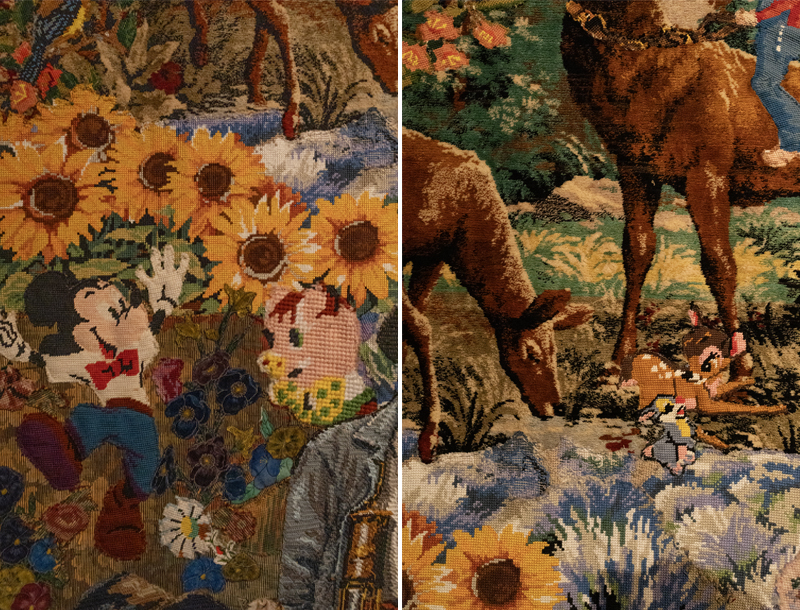
Aurélia Jubert, detail from Collection Grand Maîtres
Sharp Needles
You may be wondering, as a reader of Modern Daily Knitting, if there is knitting.
Oh, mais oui.
And it is likely to startle anyone who associates knitting with coziness and comfort. That is to say, most of us.
Stéphane Blanquet’s terrifying mixed-media installation–allotted a tiny torture chamber of its own on the ground floor…
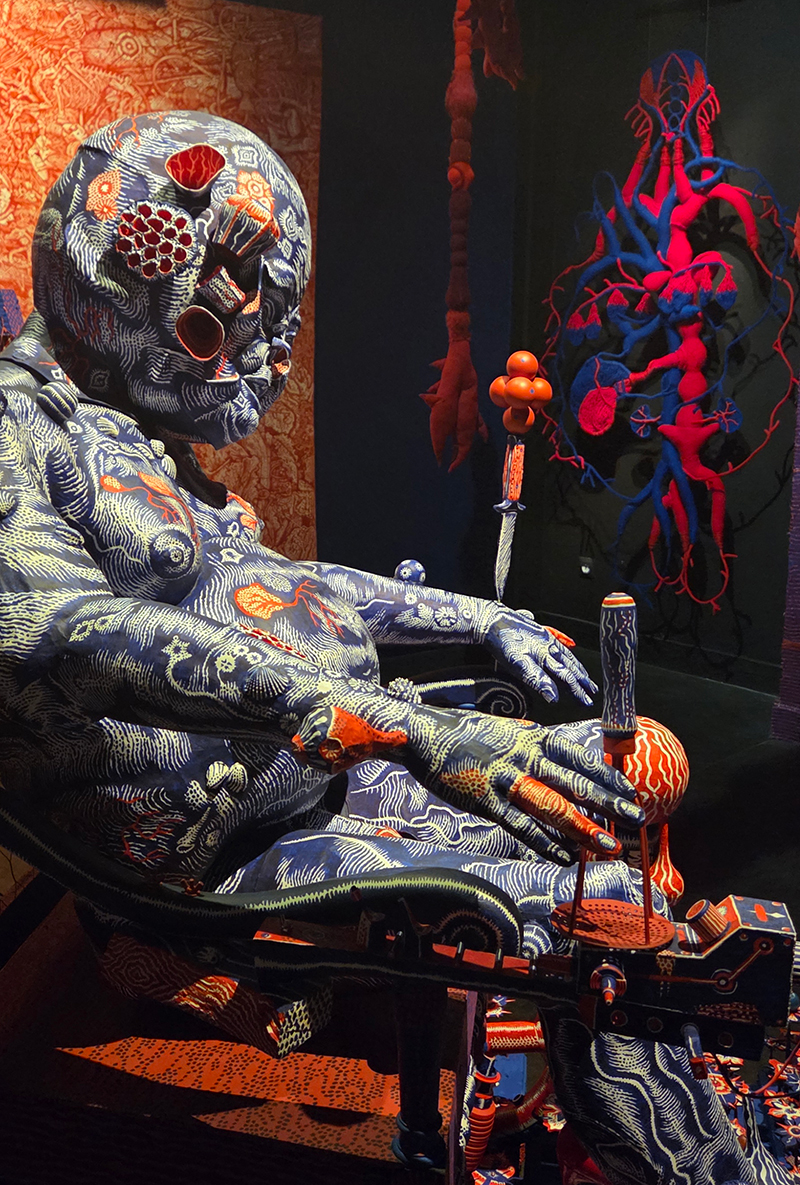
Stéphane Blanquet, Kugelberg-welander (2024)
…includes two monstrous, sculptural hangings that turn stockinette and i-cord into the bulbous, glowing entrails of some unspeakable and probably malevolent being.
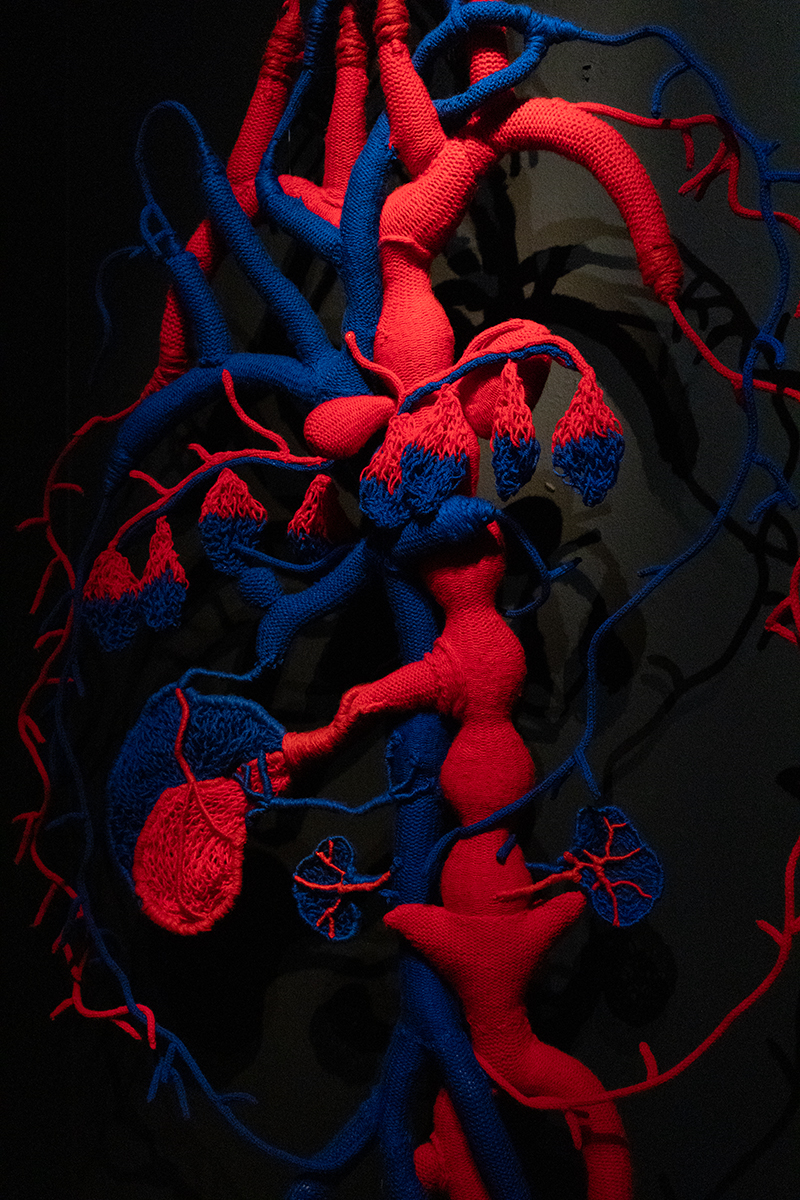
Stéphane Blanquet, Système veineux (2025)
On the upper floor, Juliette Imbert confronts the visitor with a life-sized figure whose title invokes Kali, the Hindu goddess of death and rebirth.
Imbert’s Kali is covered from head to toe in a skin formed from knit and crochet panels that variously evoke armor, exoskeleton, tattoos, muscles, and pure nervous energy.
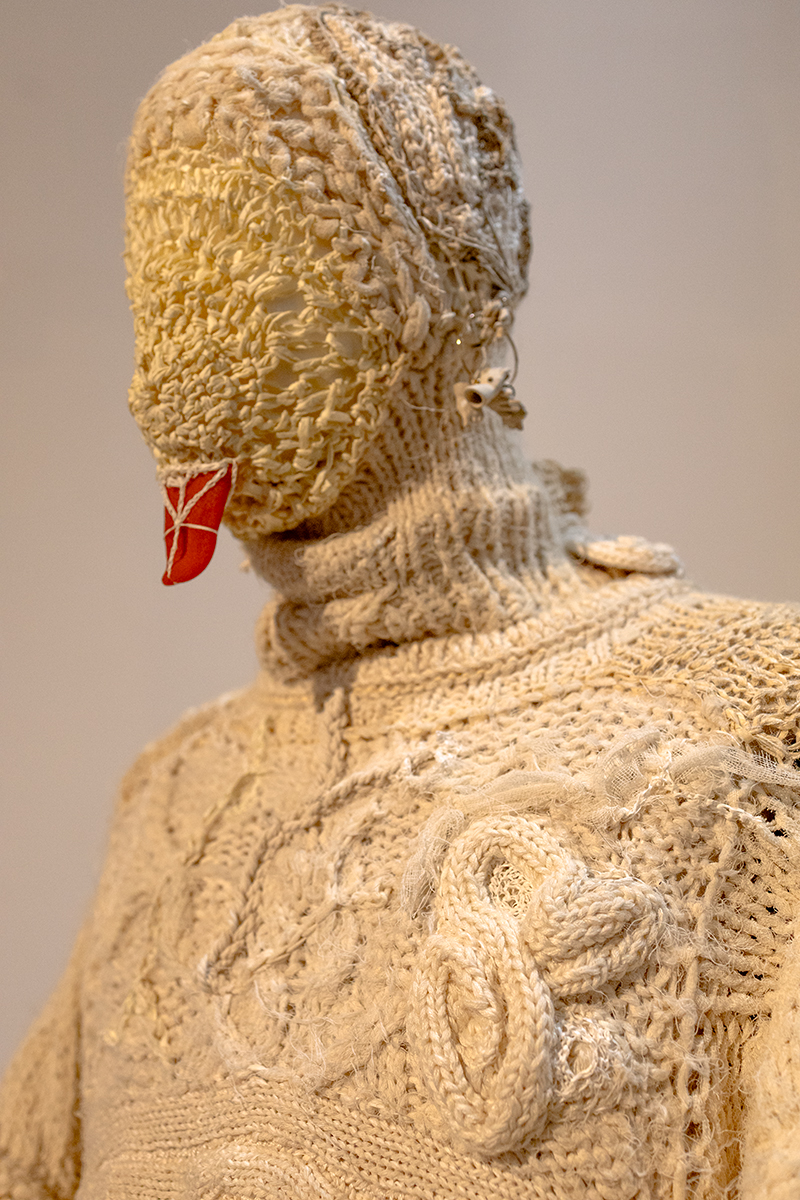
Kâli Lingua (2023), detail
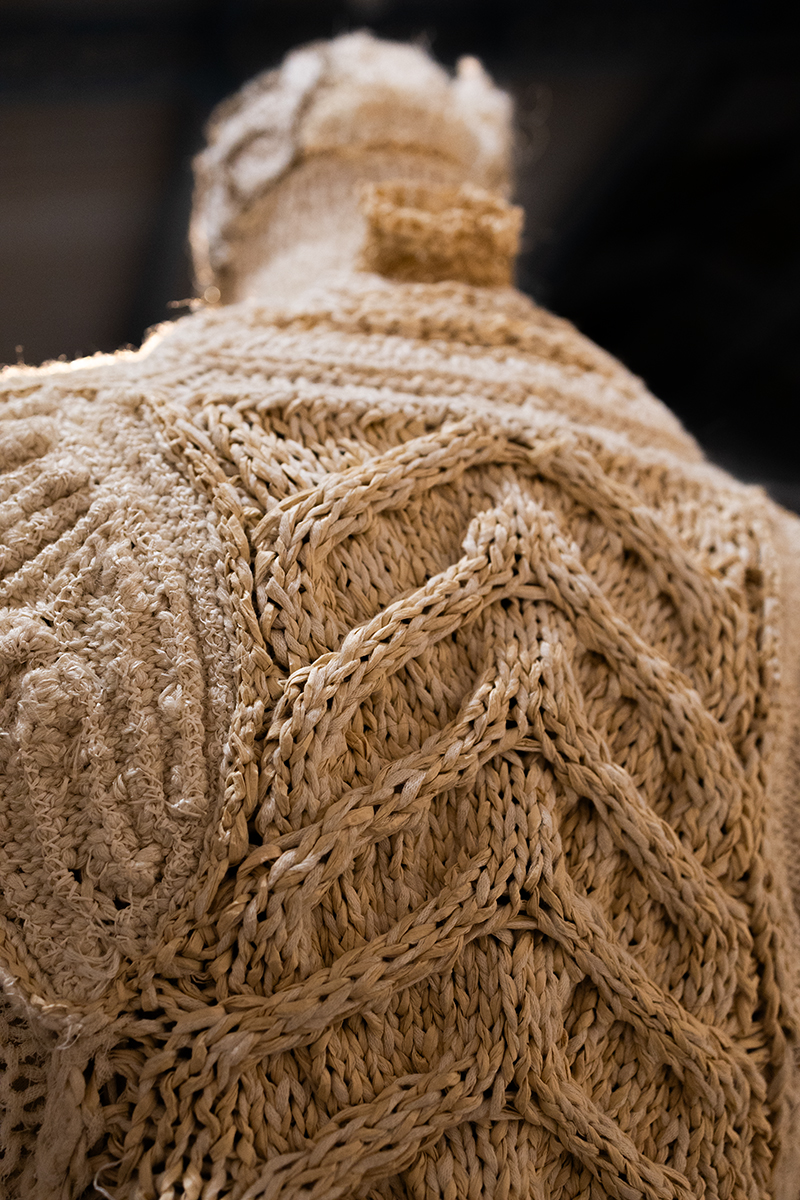
Kâli Lingua (2023), detail
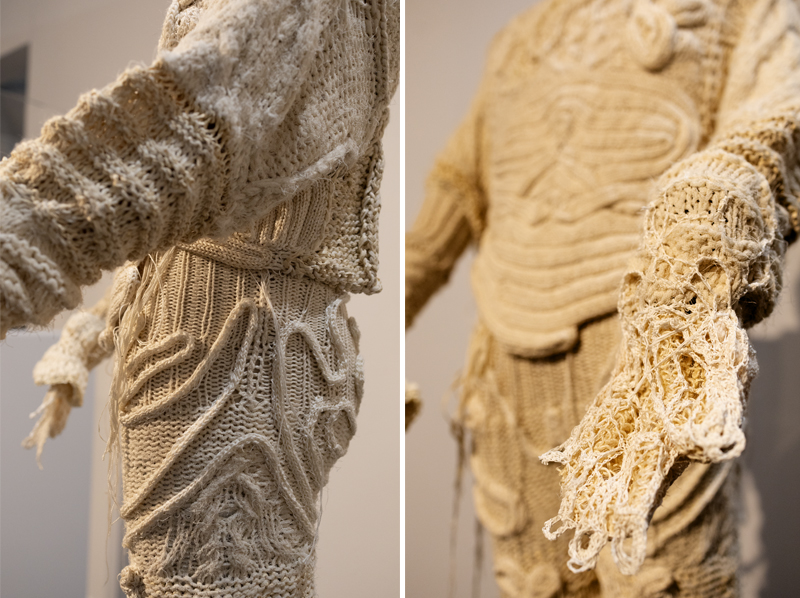
Kâli Lingua (2023), detail
On a smaller scale, Imbert presents a pair of lacy, white gloves in a vintage case. Delicate gloves threaded with red wool veins and equipped with metal claws…
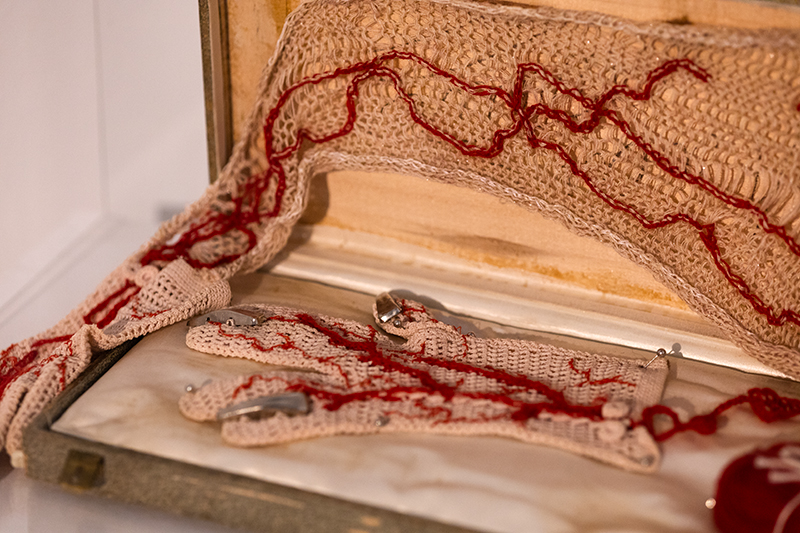
Juliette Imbert, Les échorchées vivent (2025)
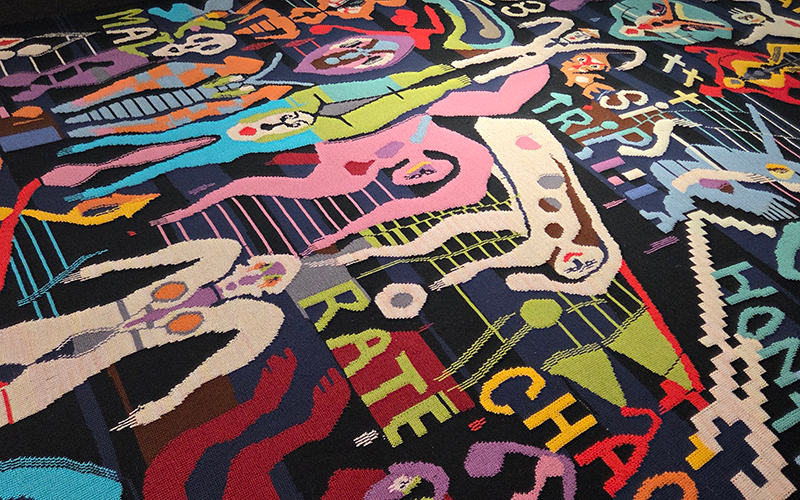
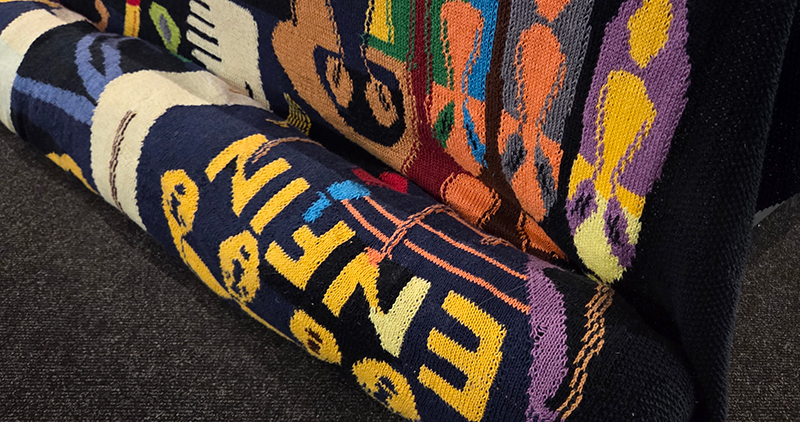
Finally, at the hub of the upper floor, is Nicole Bayle’s Le Tricot (1995).
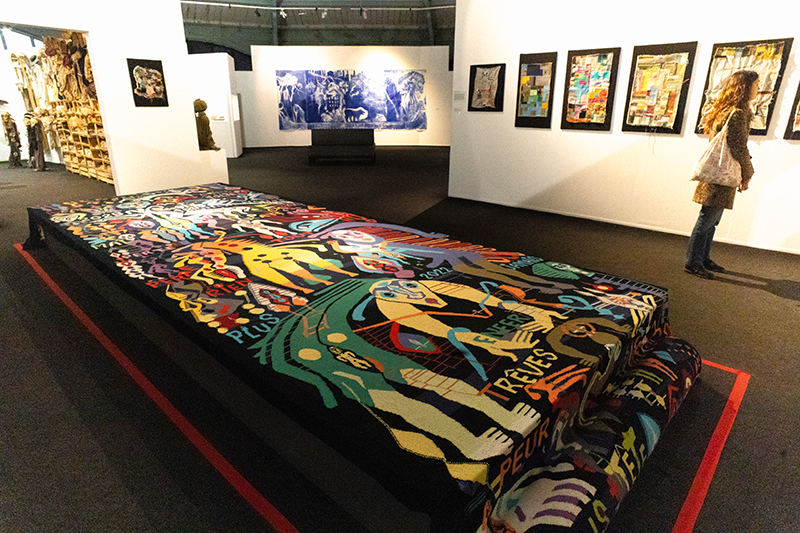
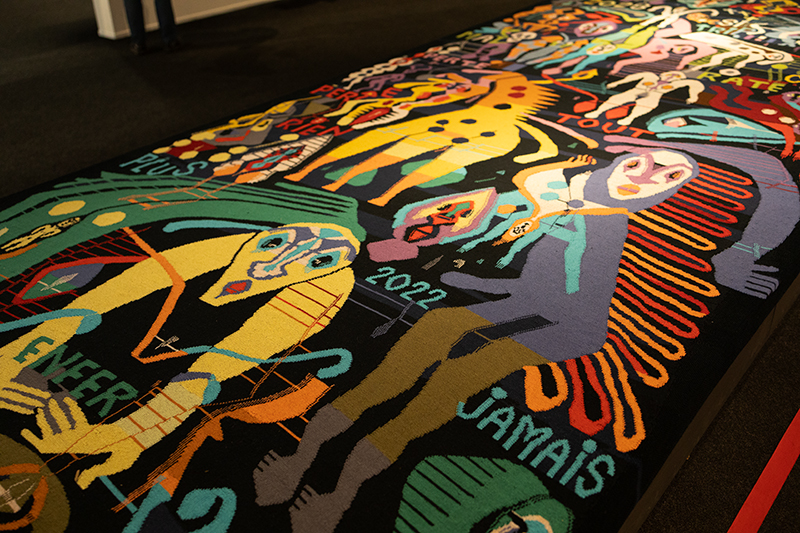
The title means, quite simply, knitting. And that’s what it is: a piece of knitting that Bayle began in 1995, and which at present measures 45 metres (about 147 feet) long.
Bayle lives a quiet and retiring life. She has no credit cards, no cell phone, no internet access. She has never flown in an airplane. She has never left France. Her chief connections to the outside world are her television and postcards.
Le Tricot was knit in front of her television, without a pattern.
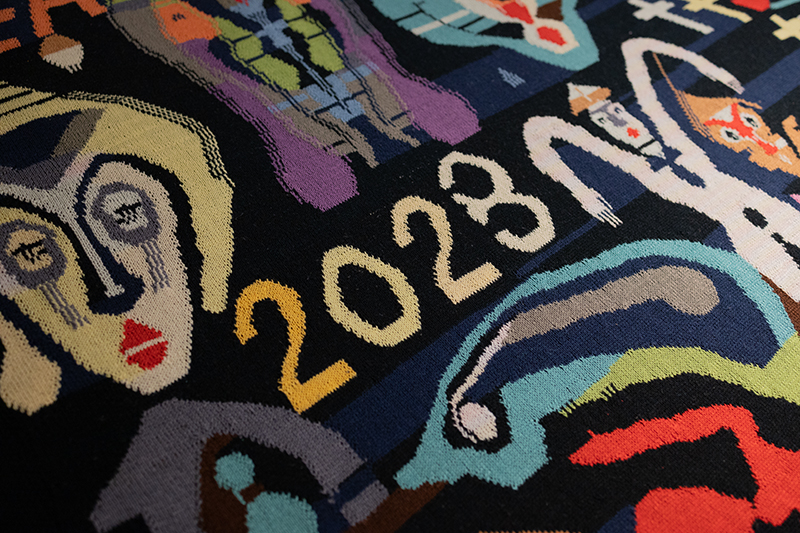
As the years have rolled along she has added dates and words among the writhing humanoid figures. Most of the words are, shall we say, uncheery: LOSS, CHAOS, MADNESS, FAILURE, SHAME, HELL.
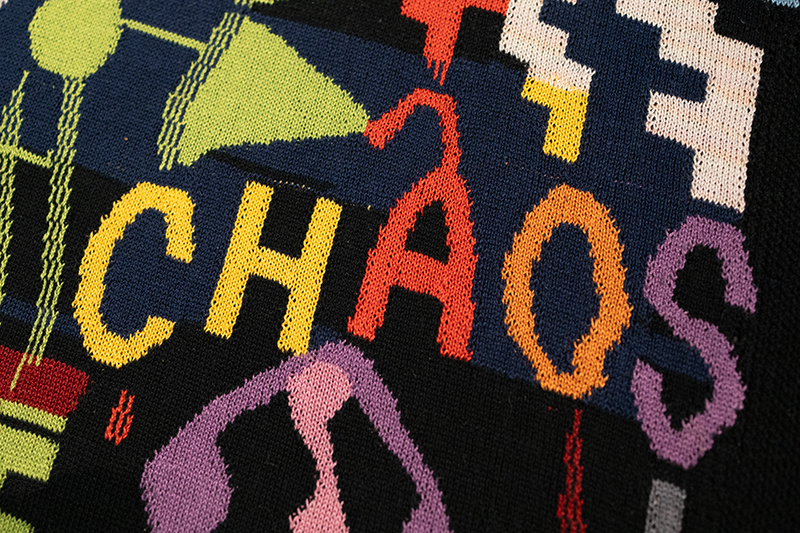
The piece is so long that it cannot be displayed in its entirety. At either end of the platform upon which it lies are sections that remain rolled up. At the top end, the final visible word is ENFIN, “at last.” Ironic, as Le Tricot hasn’t been bound off. Bayle isn’t sure if it’s finished yet.
Looking at Le Tricot made me think about a lot of things, but it especially made me think about how much knitting you can get done when you don’t have a cell phone.
Cordialement,
Franklin
“L’Etoffe des Rêves, création textile” is at La Halle Saint-Pierre, 2 Rue Ronsard, Paris 75018, through July 31, 2026. Tickets (11 euros) are required and may be purchased at the entrance. For more information about hours, accessibility, etc., visit the Halle Saint-Pierre website.
Come Shop With Us

there are some extraordinary pieces in the exhibition displaying levels of skill, ambition and artistry that i can only dream of.
thank you for sharing them with us.
I need one more trip to Paris!!!
Wow! Many thanks, Franklin and MDK, for this wonderful tour of such extraordinary works. The photographs are really excellent – especially the details – that we can almost feel we’re seeing the art in person. A fantastic way to start my day!
What am incredible exhibition. Thank you so much for sharing xx.
What an incredible exhibition.Thank you so much for sharing xx.
Oh my god Franklin, this is excellent , not only for bringing this to us but the way that you explain and show it to us, thank you very much
Greetings,
Thank you for sharing another view of art.
I was wondering, have you ever had the chance to see the famous “red dress”?
The piece of collective art is stunning and so is it’s story.
Le Tricot must be amazing in person. To see such an enormous knitted piece.
WOW! The colors in Le Tricot are amazing.
Makes my current WIP (a pair of mittens) seem humble, but on the other hand makes me feel as a knitter and sewist like I’m part of something big.
Thanks for sharing!
Wonderful exhibit…and photos! Thank you so much for writing this.
Once again Franklin gives me a view of an exhibit I will likely not see in person, with the kind of interpretation one needs an expert for.
Thank you!
Thank you for the tour!
That’s amazing stuff, thanx for sharing!
Thank you so much for sharing this. I will be in Paris the end of May. I have put this at the top of my list. Fabulous!!!
Viewing this stylized art makes ideas come roaring through. Take that pattern that you’re working on, add bling to it and personal affects through your chosen word of the year.
How wonderful ❣️ most enjoyed “etrange “ & “kali” wow! Thank you
Oh my goodness! This is all just incredibly cool. Merci!
Breathtaking. Thank you.
I think my mouth was open the whole time I was reading this. Inspiring. Thank you so much.
Wow. Thank you for sharing these photos and reflections on the works. Amazing exhibit, and I would have had no idea if Franklin hadn’t visited and written this column. Thank you. Amazing.
Wow, that was a lot to take in at 6:00 a.m. Art is meant to provoke! The use of many different materials is fascinating. Thank you for the tour.
Wow. Merci.
And for stating this:
‘This is often idealized in historical narratives as “thrift,” usually without acknowledging that thrift often arises not from virtue but from deprivation.’
Yes yes yes.
Oh, thank you so much. Not only fascinating, but I will be in Paris mid Feb., so am definitely putting this on my list!
I’m always so excited to see a new Franklin Habit writing. His eye for detail and his exuberance about the crafting world is always a joy to read. This exhibit looks stunning and it was fun to see it through his eyes.
This is incredible. I wish I could see this in person, but Franklin’s photographs are really good.
Great to meet some of y’all on Jan 18 at the HQ.
What a fabulous exhibition, thank you! May have to pop across the channel….
Fantastique. I haven’t been blown away like this in a long time. Thank you very much for turning me on to all of these artists.
Wow. Just Wow.
I love your reviews and photos of the shows à Paris! Always like a favorite art history lecture.
Thank you so much for sharing!
Wow. Double wow. The creativity just blows my mind. And being able to click and enlarge the pictures … the details are astonishing. Thank you so much, Franklin, for taking us with you to see this exhibit.
Love hearing from you Franklin and all the wonderfully interesting things happening in the fabric and art world of Paris. Thank you
Utterly fascinating..thank you as usual for your fabulous articles. All the pieces you chose to highlight were great but I was overly impressed with Le Tricot because as someone who sometimes can’t follow a simple pattern I am amazed this 147 ft piece was knitted without one..Already looking forward to reading about your next adventure in Paris.
Thank you Franklin, for sharing this astonishing exhibit! My mouth is gaping-trying to absorb the reality of a 147 foot long work of art, knit over nearly 30 years, while watching TV! I am definitely a knitting slacker.
Thank you, once again, for sharing more of the wonders of Paris.
Just WOW! Thanks for sharing, Nicole Bayle’s Le Tricot (1995) is amazing
I love to go to these exhibits when visiting abroad. It lets me see what artists of today are feeling. So glad you shared this so others might be inclined to visit as well.
I will be in Paris in June and will definitely go see this exhibit. Thanks for sharing it with us!
Thank you, Franklin!! What an amazing visit you made!! Thanks for sharing your visit!!
Thank you so much for such a detailed tour of this exhibition. Especially your comments enhance the understanding of the particular pieces.