
Genius Tips
On Heads, and Keeping Them Warm

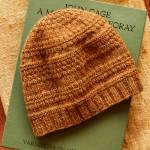
A member of the MDK team was recently hanging around in the MDK lounge, and they told me about a question they’d seen: How do you measure for a hat? The person asking said that the hats they make are always too big.
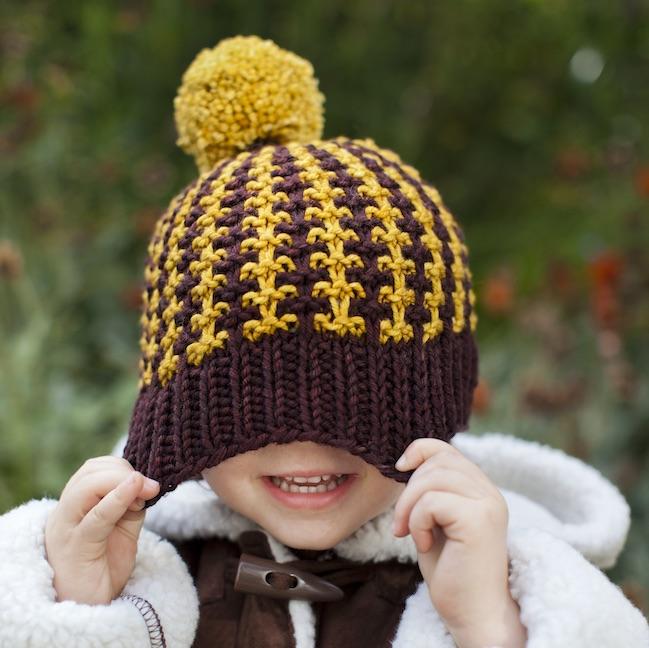
Slip-Stitch Cap from MDK Field Guide No. 8: Merry-Making
It’s an important and timely question—the weather’s changing fast, and many of us are thinking about gift knitting. Hats are an excellent gift, as they’re darn useful and pretty quick to make.
Other than the actual knitting stuff, there are two things to know to be a successful hat knitter: 1. Heads come in different sizes, and 2. A hat should NOT be the same size as the head that is to wear it.
Head Sizes
Hat designer extraordinaire Woolly Wormhead has an outstanding head size table on their website.
“Head circumference” is around the widest part of your head, above the ears, around the forehead and the back of the head.
To be clear about the numbers in this table: these are measurements of actual heads (not hats), and they are averages. Not everyone’s head will correspond exactly to these categories.
My own noggin lands exactly in between the child/teen and adult sizes. And hair can make a big difference here. If you’ve got lots of natural or curly hair, you might find yourself with a head measurement that fits into a larger category than expected.
If you can, it’s always better to measure the head of the person you’re making the hat for, but if you can’t, Woolly’s table is your best resource. I used a version of it for my own hat knitting book.
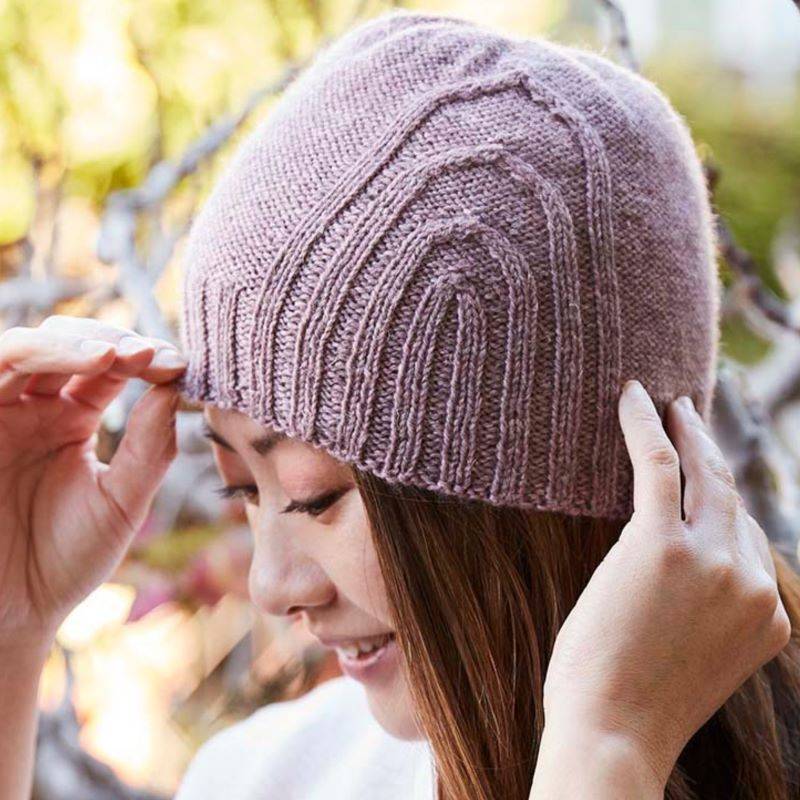
Arcade Cap from MDK Field Guide No. 14: Refresh
Choosing the Size
As to hat size, there is a trick to this!
Actually, there are two.
For adult and teens, the hat needs to be smaller around than your head circumference, about 10-15% smaller.
That is, for an adult head of 22″ (56 cm) around, your hat needs to be 2-3″ (5.5-8 cm) smaller than your head. This is what it means to wear something with negative ease: the thing is smaller than you, so it stretches to fit.
There’s more on ease and measurements here.
For babies and young children, because their heads are soft and still growing, the hat should be closer to the actual head measurement. In formal terms, we would say that a baby or young child should wear a hat with zero ease. As kids grow, that negative ease will sort itself out.
When looking at a hat pattern for an adult, then, you need to choose a size with a finished measurement that offers the appropriate amount of negative ease.
For my modest 21″ (53.5 cm) head, I look for a hat pattern that offers a size with a finished circumference of about 19″ (48 cm), give or take. If, for example, if you’ve got a head that measures 25″ (64 cm) around, you’ll need a hat pattern that offers a finished size about 22″ (56 cm) around.
Remember, when looking at a pattern, “finished” or “actual” measurements indicate how big the thing will be when you’ve knitted it. Take your own body measurement, add or subtract the amount of ease required: that’s how big your thing should be when knitted. Then look in the pattern to find the instructions that will give you a project with the finished measurement you need.
My small head is why I’m not the biggest fan of hat patterns that come in a single size.
We’re used to seeing one-size-fits-all styles in the stores, but that’s a decision driven entirely by convenience for manufacturers. It’s true that a hat of say, 23″ (58 cm) around, can be worn by most adults, but it’s going to look really different on my tiny little short-haired head than it is on a larger person with lots of glorious natural hair.
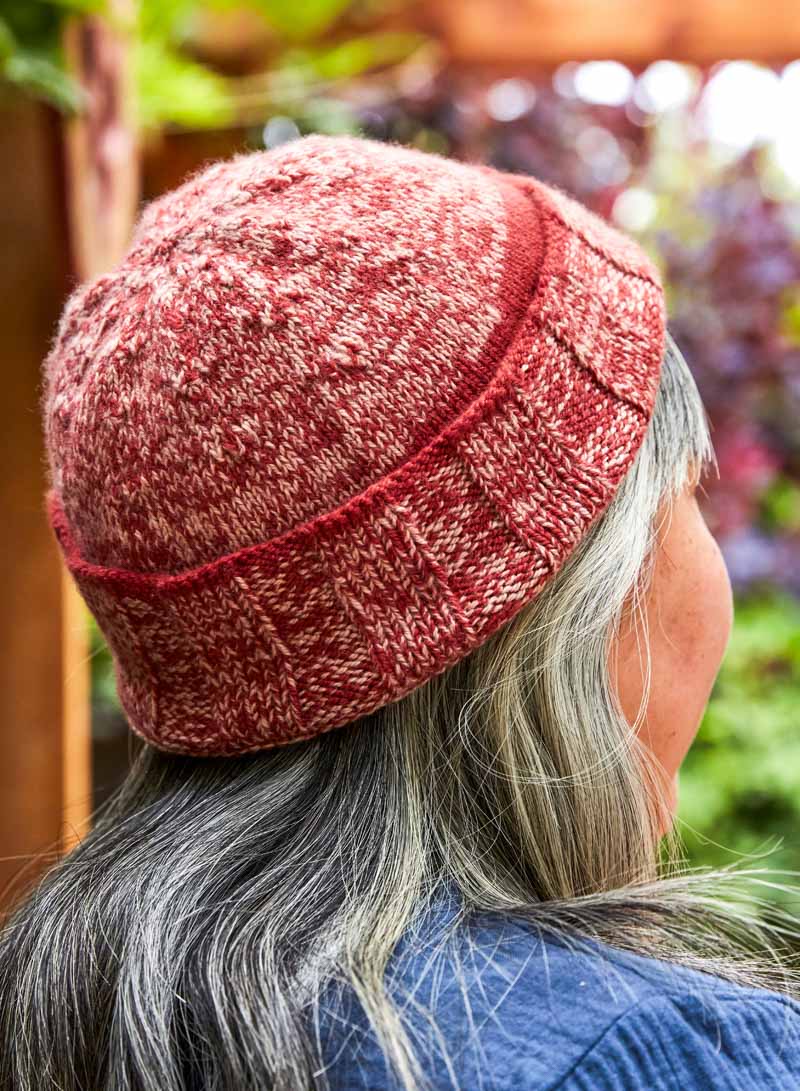
Striped Marl Hat from MDK Field Guide No. 19: Marls
If we’re making something ourselves, we have the opportunity to get the fit exactly right, the way we want it.
The second part of the magic trick is to do with the length. Hat depth is generally pretty adjustable in patterns and where it lands is often a point of preference: exactly how much ear coverage do you want or need? If it’s going to get really cold where you are, consider making the cuff extra deep so you can fold it over.
But know this: no matter whether you’re looking to cover your ears or not, the hat depth needs a bit extra!
When you’re wearing a hat with negative ease, when it stretches in circumference, it will shrink up a bit in length. So always add about half-an-inch (a cm or so) to the depth of your hat, so it’s not too short when you put it on.
And with this knowledge, go forth and finish up that gift knitting list!
If you are itching to cast on any of these hats (plus dozens of other nifty knitwear possibilities), all of our Field Guide ebooks are on sale on Ravelry.com until 11:59 p.m. Eastern time on December 2. Click here for the details.

Thank you! Very timely and practical advice
Great post. Thanks for sharing.
The first hat I ever knit for an adult person was for my husband. I made the pattern up myself, guided by what my husband wanted and by Barbara Walker’s “Knitting from the Top” – the hat fits fine (it has been a well-loved and often-worn piece for years now), it was joyful knitting and in the end I felt pretty proud and confident.
I can also recommend Ysolda’s and Tincan Knit’s hat patterns because they offer multiple sizes/gauges and I can use them as a canvas for my own designs/ideas or just as well written instructions for basic hats when I need some mindless train oder TV knitting.
Thanks for the reply!
Good suggestions… but I’m always going to recommend my own patterns first, as my hat book offers a multi-size, multi-gauge approach that even offers the formulas if you want to go a step further and calculate it yourself!
Oh, I somehow must have overlooked the Link to your book – since I read your books on mittens and socks and found them very helpful, I will have a look into your hats-book as well!
Thank you, Kate! I think that the fiber you are using needs to be factored in. Merino comes to mind, superwash or not…
Hi Kathleen,
You’re right, fibre can make a difference somewhat, although a lot of that is solved in swatching and washing your swatch… There’s a lot more to say about hats, actually, for which there isn’t always room in an MDK post. (Consider this a bit of a plug for my own book… ) But hopefully this is a good starting point for people!
What pattern is the hat in the landing picture?
It is the Jacobs Hat from MDK field Guide 28: https://www.moderndailyknitting.com/patterns/jacobs-hat/
I have knit this hat a couple of times and it’s super fun to work, plus forgiving of careless errors and easy to make taller or shorter. Highly recommend!
Is it from number 28? Norah Gaughan – Renewal?
Yes that’s the one!
Just came to ask that same question!!
I would love to know too!
This is helpful and timely inspiration. Thanks!
The first hat I made was a Jennifer Berg colourwork design for Knit Stars. Since it was my first colourwork, it ended up as an unintended ribbed hat (oops, too tight on my floats!). Undo. The second time went better, except it didn’t fit. Who knew heads came in such different sizes (hence, the above post – thanks Kate)? I contacted Jennifer, who was very helpful (thanks Jennifer). I added a whole pattern repeat to the width and it turned out great and is now a favourite hat.
Not sure how I could surreptitiously measure heads for a surprise hat? Have to think about that!
If you can get ahold of a hat the person likes and wears, then measure that…might involve some quick measuring while they are off fetching a cup of tea or heading to the facilities!
Just finished my first hat & I’ve been knitting for over 40 yrs. A friend wanted a hat like one she has & loves so LUCKILY no size worries. Thanks to you I now know about that! I matched the existing hat which looked easy: 1×1 band, stockinette in the round straight up, then decreases ea side for a couple inches, then some grafting in a straight line between those decreases to close the top. I had too many sts one side vs the other for the graft! Hindsight is always 20/20. Sigh. Luckily pompoms (first time making those too) go on each side where the decreases meet the graft & would hide my mistake. Phew!! (There must be the same # of sts on each needle to graft so instead of my line going straight across between the decreases, the line was slightly askew!) She wants another, I’ve learned from my mistake, so the 2nd will be easy!
Thank you for this tutorial! I have often wondered why some of the hats I make fit terribly! This article is a keeper!!
I so needed this article a couple weeks ago. Knitted the Stripey Scrappy Hat in adult S/M and it’s way too big. (Maybe I’ll gift it?)
It’s 24 degrees this morning and I need a hat that covers my ears (ha!). I think I’ll take a shot at the Jacob’s beanie. Stay warm everyone!
I knit a lot of charity hats for my daughter’s non-profit. We have several standard stitch counts, and then as noted, the depth usually works itself out. HOWEVER -if I’m not sure where I am as I’m knitting along, I hold the hat-in-progress against my ear, and then see how high it goes toward my crown. Imperfect, but better than nothing. If you WANT a hat to hit a certain person, at a certain place, measure from the crown of the head to the ear placement and plan from there.
I just finished knitting my 7th 1898 Hat. I learned about the 5%-15% negative ease rule from a Roxanne Richardson video. I’ve always tweaked the 1898 pattern to fit my baby Grands and so far it’s worked. That pattern is written for only one size.
Love that pattern too because it truly covers the ears! Thanks to Kate’s article and the comments today I know what I need to do to make it better still.
Never too old to learn! Very valuable information.
Can you send me the pattern for the hats at my email. My email is No**********@***oo.com
All the patterns are linked in the post, just click on red words.
Thank you! I knew about hat sizes, but never thought you must also increase hat depth. Brilliant.
Great advice! The beanie I made for my husband came out too big so now I need to make another one to fit better.
You might could felt that beanie to a slightly smaller size. Of course you might also find someone with just the right size head! Happy knitting!
I’ve been knitting beanies and selling for many years. I agree that they need to be a tad smaller than your head. I have an extremely small head, usually knit children’s sizes for myself.
Terrific article Kate. Timely and concise. I’m going out to buy cashmere for a hat for my brother after this great holiday idea.
Having just finished a colorwork hat I have my fingers crossed those floats are stretched enough!!! My granddaughter still has my first colorwork hat on one of her dolls!!! Did anyone else knit a small Setesdal Hat?
Love this review of measurements!!! Thank you and looking forward to some math on Friday!!!
Great post. I make hats for sale at local farmers market and I constantly have to explain how a hat should fit. From now on I’ll use your explanation.
Thank-you for that.
Hi. Is there a pattern for the golden and rust colored hat shown at the beginning of this post from 12/1 ? It’s on top of the green book.
Thank you!!
Thanks for the info. Very seldom have I found such
great info.
Thank you, brilliant and printed Woolly Wormhead’s page! I’m about to embark on making my first hat from scratch to match a cowl I designed. I used a very squishy, soft bulky merino and think I need to make the gauge tighter on the hat so that it won’t get baggy or slide off, even with negative ease. As someone who lives in a windy spot in Maine, I always find I want MORE over the ears, especially in deep winter, and often longer because wind chill is real! I’d read a rule of thumb about 10% smaller than the head for which it is destined, which matches up, but really glad to have a ballpark number for how much length you lose to the stretching. Thanks again, Sarah
Disappointed you don’t identify the hat in the first picture – above the article heading.
I love knitting hats but they ALWAYS turn out too big! I swatch, pick the right size to include negative ease, etc. Guess I need to practice more. I do use 16″ circulars and switch to Magic Loop for the crown. May try using Magic Loop for the whole hat and see if that makes any difference.
Easy knit projects
A trick for hat height – if one stretches their hand from their ear to the top of the head (thumb at the bottom of your ear and pinky at the top of your head) that’s the distance you need to knit the hat before you start decreasing in order to cover your ears. It works for the adults I know at least…. And since most adults have a handspan (the stretched distance between thumb and pinky) of roughly 8 inches – I know I can knit a hat from brim until the point I’d decrease about 8 inches and the hat will cover their ears. Always best to go a row or two more if you really want the hat to cover their ears.
And pdxknitterati taught me that when do a color work hat, use the brim and the rest rows of just plain color to add height without disrupting the pattern.