
Beyond Knitting
Nature Printing Society
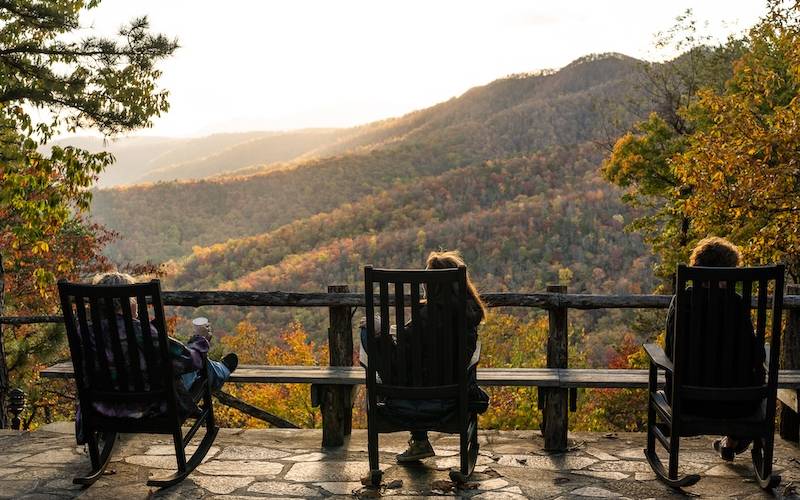

I recently returned from a fascinating gig as a photographer-for-hire with the Nature Printing Society on top of a remote mountain in Western North Carolina.
The NPS Workshop is a weeklong gathering of artists devoted to nature materials, teaching others dedicated to the same.
Art supplies include leaves and seed pods, feathers and bark, flowers and fish. The processes blew away any definition of printmaking I’d had till then.
If it can be pressed, inked, molded, transferred, pounded, rubbed or otherwise made into an image on another surface, the nature print artists did it.
Wildacres Retreat in Little Switzerland, N.C., provided a stunning deep woods mountaintop backdrop for eighty attendees, including the dozen master artist printmakers who led day-long classes.
Teachers became students on their non-leader days, making each studio a chance to rub elbows (and sometimes also leaves and branches and fish scales) with amazing talent.
Photographing artists creating with passion in a beautiful setting is a wonderful work week. Most days I scooted from studio to studio, documenting the concurrent classes. Most classes taught a process and a project that could be completed by sunset. Others were open ended.
A personal highlight was my day spent learning octopus printing. It’s exactly what you think it is; I learned to properly ink and print an octopus. It’s not as easy as it sounds. There’s a lot to learn about composing nature prints to, well, look natural.
I tried to arrange my octopus legs in graceful underwater motion and each time ended up with a happy waving friendly octopus vibe. The experienced artists’ octopus flowed across the page.
Takuga
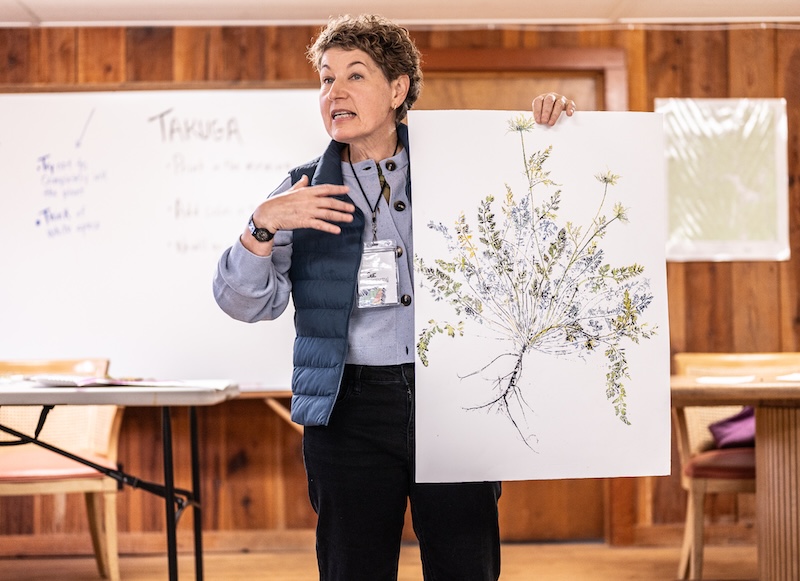
Boston area artist Sue Fierston teaching Takuga, the Japanese art of printing botanicals with ink and watercolor.
Direct Gyotaku
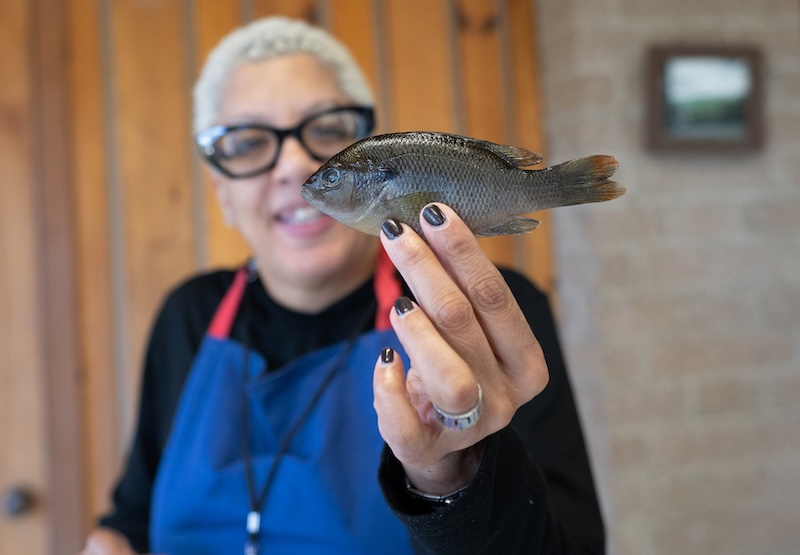
The traditional art of Japanese fish printing attracts a passionate following to the NPS retreat.
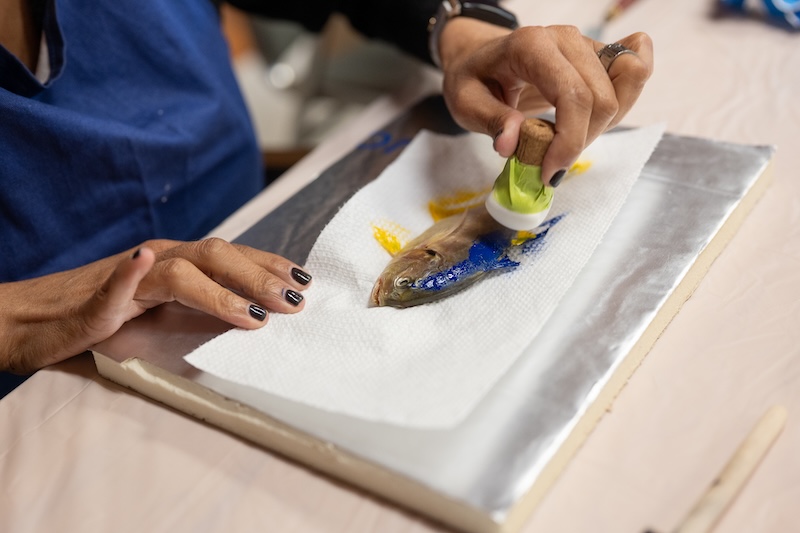
In the direct process class, beginners learned how to ink their fish using tampos, a handmade ink dauber that allows the artists to roll the ink delicately onto rounded areas.
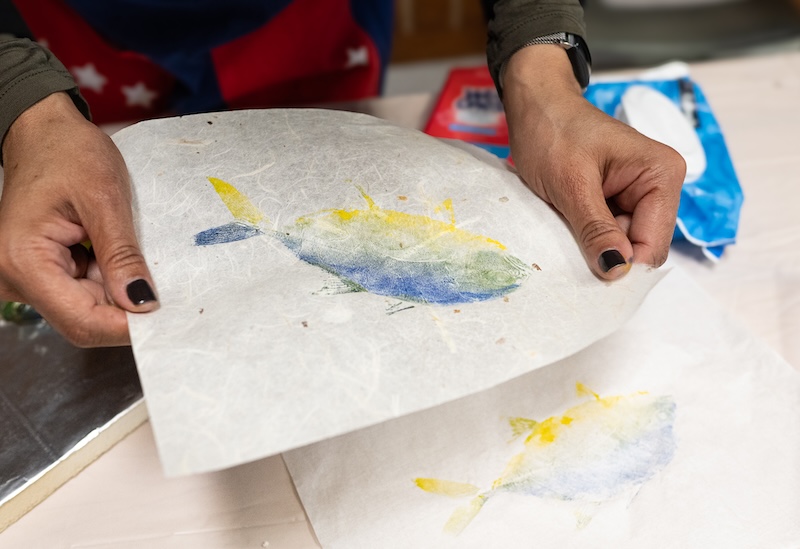
Each teaching artist shared their own techniques, from carving a styrofoam bed for the fish to lay in while printed, to positioning and holding out fins and details with clay or cardboard shims and whether or not to moisten the paper used for printing.
Precious Metal Clay
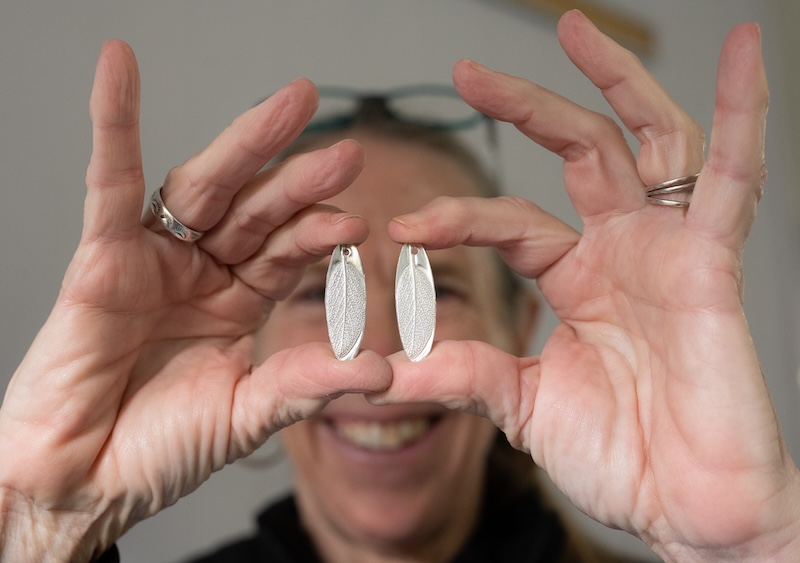
Students made silicone rubber molds and cast silver clay nature jewelry.
Extraction Dyeing and Printing
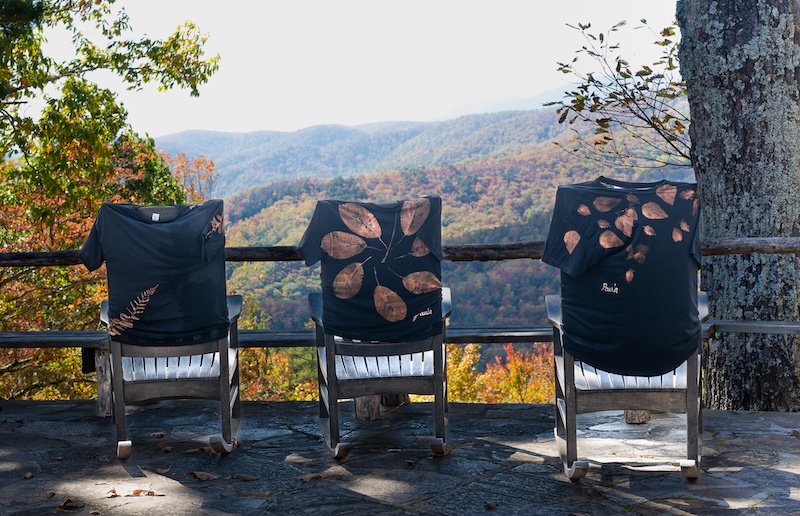
A surprisingly straightforward process of coating botanicals with a bleaching mixture that strips the dye out of dark fabric when put into contact. A row of shirts drying on the Wildacres retreat main patio were solid dark blue; the extraction bleaching yielded a coppery gold tone print.
Indirect Gyotaku
The art of Japanese fish printing indirectly has the artist preparing the fish and covering it with a thin pieces of silk or paper, and using a tampo to carefully dab the ink onto the surface over the fish.
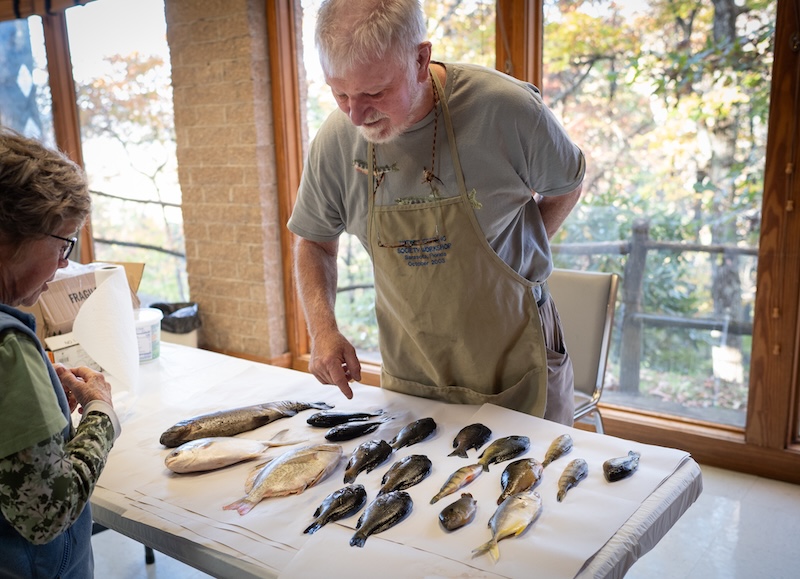
Chris Dewees discussing the selection of fish for students to choose from in his class. Chris is one of the founders of the Nature Printing Society in 1976. He is a passionate ecologist with a Ph.D., a career in marine fisheries, and a lifelong dedication to gyotaku.
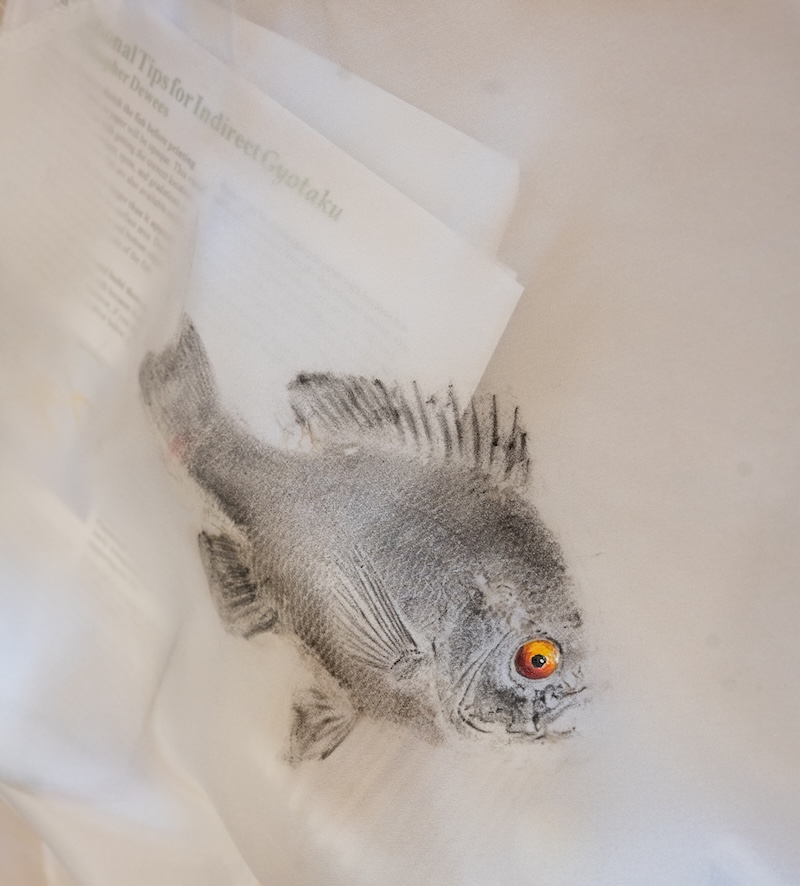
Details and often backgrounds are added to the fish print with paints.
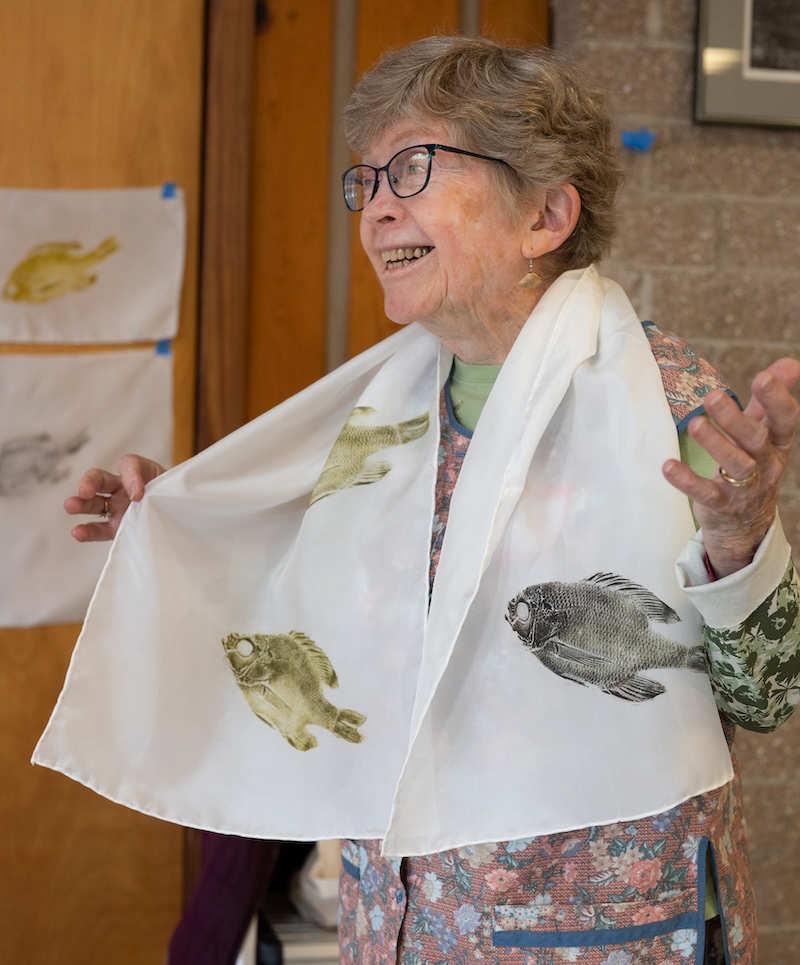
A finished indirect gyotaku printed scarf.
Monotype

A press room studio allowed artists to create monotypes using papers, inks, nature, and found materials by adding pressure.

Monotypes are one-of-a-kind prints. Each time the materials go through the press, a different combination of placements and colors is created in the work.
Octopus printing

Coleen O’Connell demonstrated a small starter octopus, and showed that going into the dried print with colored pencil can brighten the suckers on the legs to bring out a crisper definition.
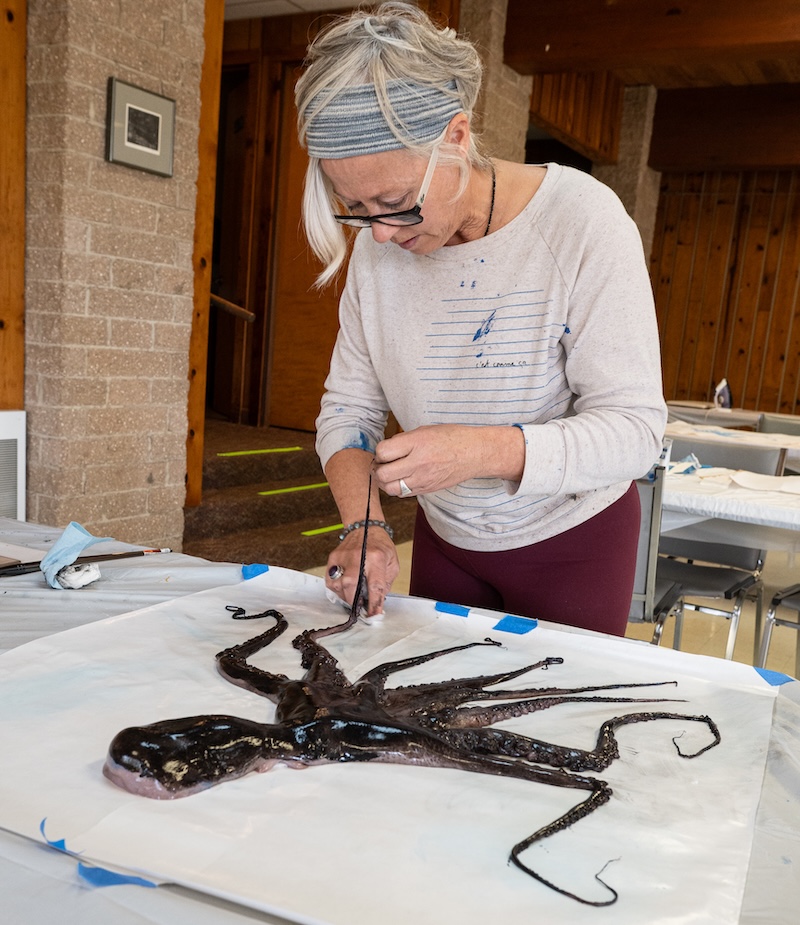
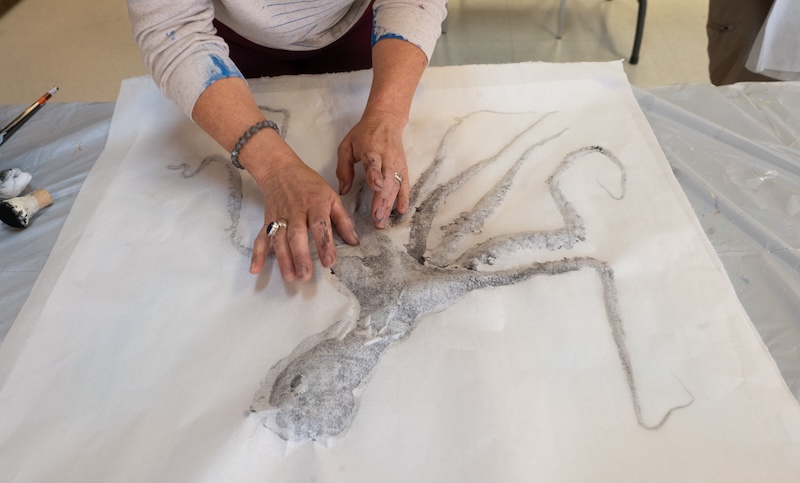
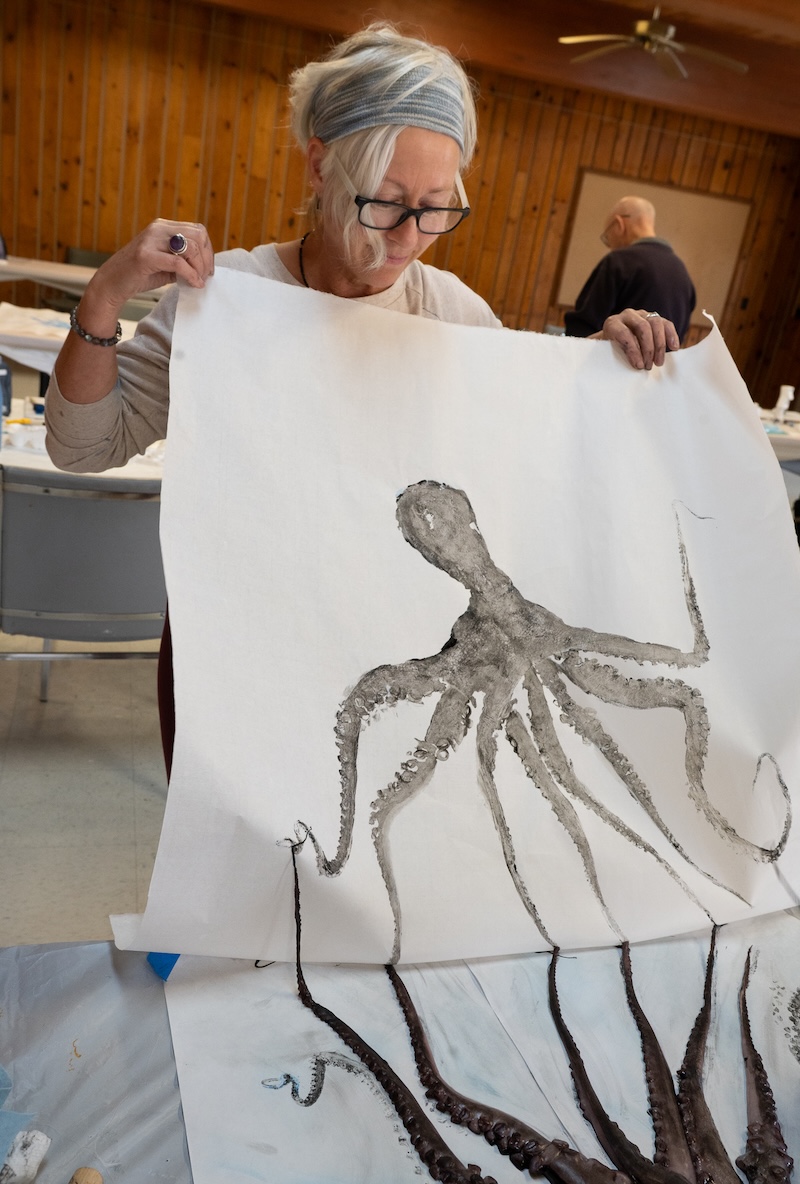
Rachel Reeve, a Nova Scotia based artist arranging a large inked octopus, patting the print paper onto the inked octo, and pulling a print.
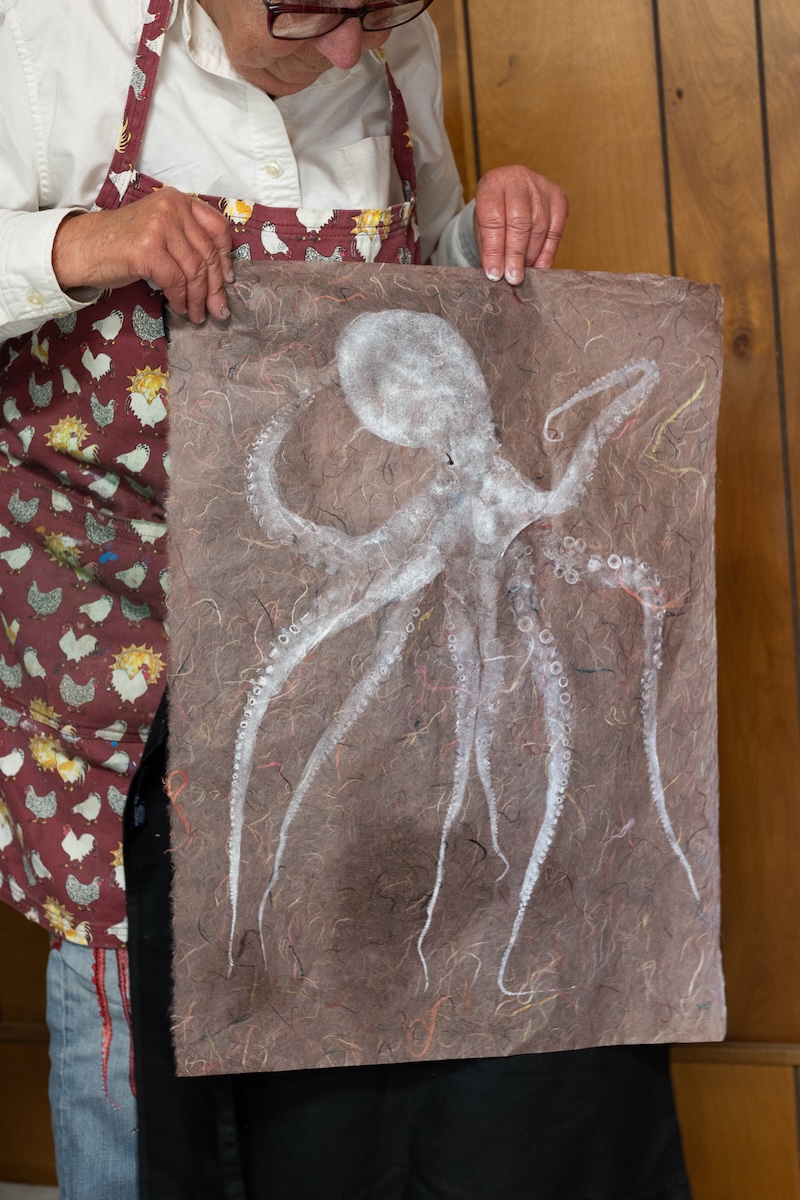
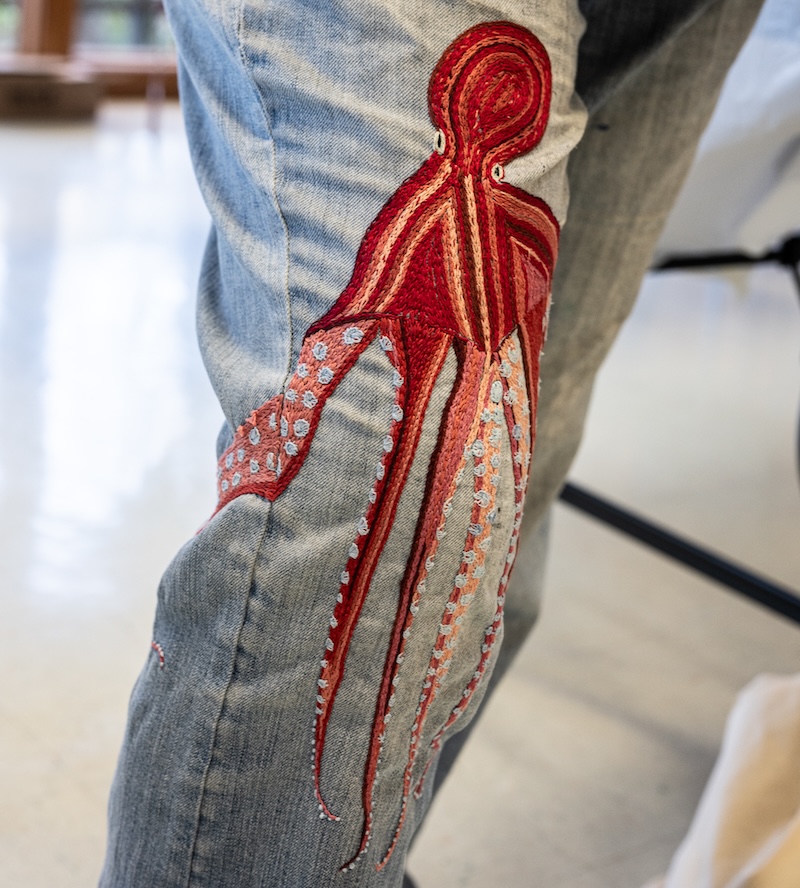
O’Connell shows a freshly pulled print on brown handmade paper, and a stitched detail from her jeans, based on a print she’d made.
CollageFrottageDecoupage
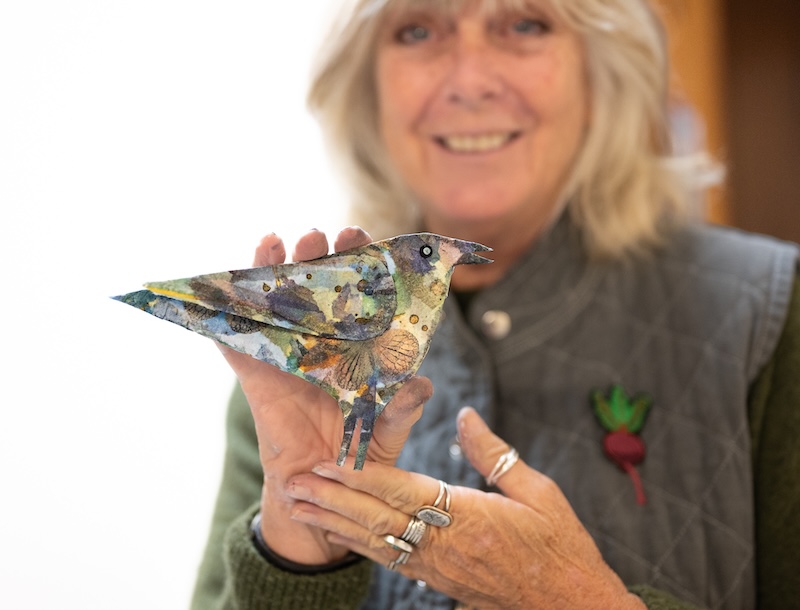
Bee Shay, a Nantucket-based artist, holds a bird from a class that included charming paper projects made from nature rubbings, painting, and collaging. Bee was one of the organizers of this year’s retreat.
Encaustics
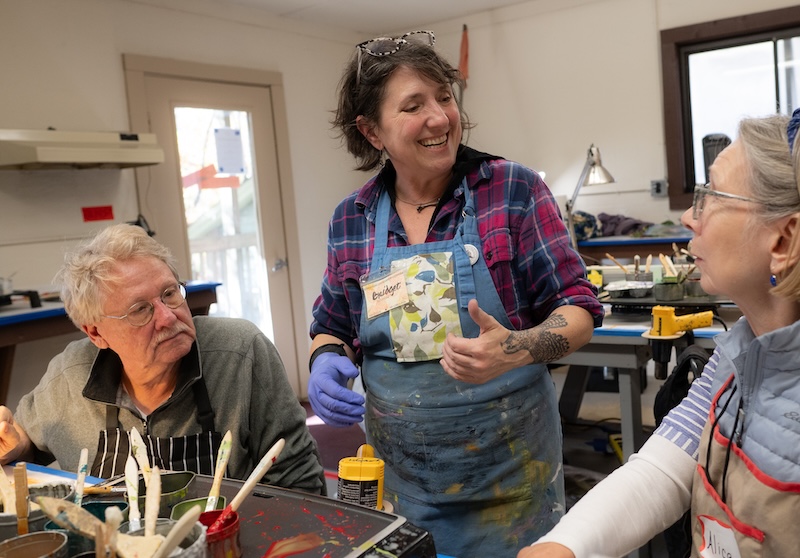
Artist Bridget Benton taught a class in encaustics: printing, collaging, and painting with wax—a process that includes use of heat guns and molten pigmented wax to build up layers..
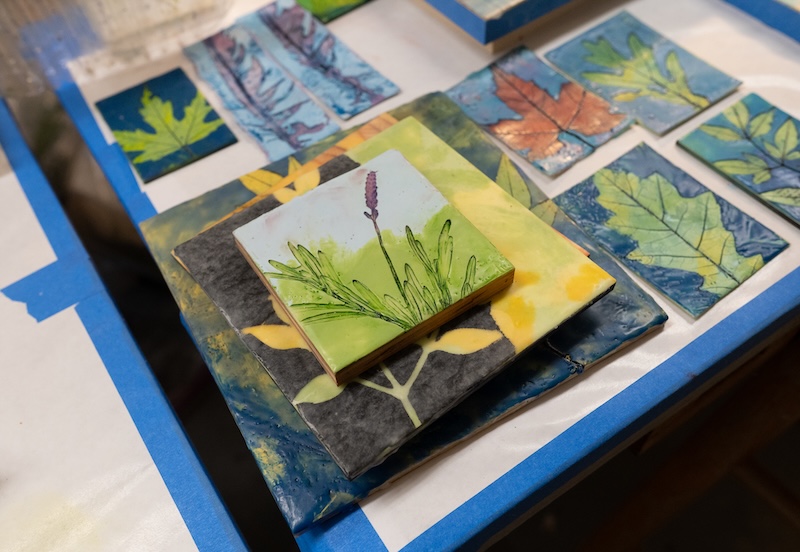
The Nature Printing Society will gather for its 50th annual retreat in 2026. Membership is reasonable and well worth the adventure.
Come Shop With Us

I’m speechless
I Know!! OMG. Could this be as fantastic as knitting?
Exactly. Sitting here agog.
OMG! I have now added another event to my bucket list. Thank you so much for sharing this! What an experience!
You’d LOVE this. Your people.
I know this will be a buzzkill response but octopus (and probably fish) are intelligent, sentient beings. Not sure whether that was acknowledged and how respectful the use of their bodies were in these classes.
Hi,
I’m the past president of NPS and you bring up a good question.
Some gyotaku artists document their own catch of the really big or unusual fish. Others collaborate with scientists, such as those at the Monterey Bay or Scripps Aquariums in California, to create art from precious and unusual fish that have died in their time. Other artists use fish to create multiple prints that experiment with shape and composition, often freezing their fish and reprinting them in different combinations. The contributions of these fish are as art, not as food.
Artists teaching this fine art use fish that are commonly available and sturdy, often getting 10-12 prints from each fish. These fish have been unrefrigerated for 12 hours or more in the printing and washing process and touched by many people, so the fish can’t be eaten, but these fish too are often frozen at the end of class and reused.
Of course it is each artist’s choice whether or not to print octopus. Many of the octopus we print at NPS workshops are ones that have been caught by accident in large fishing nets. Our members are often friends with local fish distributors and fishermen, and these people let us know when they have unusual fish, like octopus, that we might want to print.
For more information, see our website at this link: https://natureprintingsociety.org/society-forms-documents/
kind regards
Completely agree about using the fish and the octopus. I know that the fish printing has been an honored practice in Japan for eons. Time for this to stop.
I agree. The work is beautiful, but there was no need to kill the animals whose beauty was celebrated here. Very disturbing.
I’m heartened to see I wasn’t the only person who had this reaction. Sometimes artistic traditions from other cultures make perfect sense in their original contexts but don’t necessarily translate well to other places/times. Not to denigrate the artists, their work or the traditions, but in 2025, in the context of “art camp,” animals should not be art supplies.
I had the same reaction. I am, perhaps incorrectly, assuming these are not simply found octopodes, but instead that they were caught in the same way that the fish were? I’m not sure what to say except that I have a really hard time seeing dead animals used to make art in this way…
I came here to say this too. I think we’ve made some progress on educating ourselves about this amazing creature, but obviously still have a really long way to go. May they live in peace in thier homes in the sea.
Otherwise…a wonderful post! I was especially drawn to the fabric printing where the leaves bleached the fabric to a copper color. Gorgeous!
I agree with everything said here. It was sickening to see these creatures used to make art.
I am just reading “Remarkably Bright Creatures” by Shelby Van Pelt, whose hero is an octopus. It was chilling to read about this use of some of these beautiful, intelligent beings.
Agree: horrified to see this on MDK. I read this blog to read about knitting, not see wanton images of dead animals. Very very upsetting and unpleasant. Anyone who enjoys this should take a long hard look at themselves.
I agree. It’s depressing to see these beautiful, innocent creatures, with whom we share this world, losing their lives so we humans can make art with their dead bodies. Cruel, selfish, and uncivilized. We should know better. Live better. Be better.
Agreed, and I find myself a little shocked to be scrolling past pictures of dead animals on MDK this morning. I wonder how the general sentiment might shift if the crafters were making prints of sheep corpses?
I was thinking bunnies, chipmunks, gerbils tho sheep corpses possibly more relatable to this audience. So many beautiful things can be made with leaves or shells or other found stuff not causing pain to subject or viewer and using what many would consider waste. I dunno . . . . . . .
Me too. I don’t even know what to say except what a waste of a life.
I agree. This has really upset me. For what it’s worth, I’m a vegan (personal choice – appreciate it’s not for everyone) so obviously have a certain perspective on this, but there’s a huge difference between an omnivorous species (humans) eating animal products and using them for printing.
I couldn’t agree more. I’m genuinely horrified by this
My thought too!
My thought, too. Especially octopuses. Hard to say how they acquired the specimens, though.
Wow. I will have to share this with my very artistic friend and art teacher. Such a breadth of subject matter and techniques. Bearing in mind Lizziebelle’s very thought-provoking comment, I was very tickled by the intellectual (not physical) concept “starter octopus.” You don’t get to hear these two words together every day of the week. We tend to label ourselves as science geeks, tech geeks, drama geeks, etc. But Art and Music are for everybody. Thank you, Gale.
I enjoy everything that MDK puts out but rarely (if ever) comment. These works of art are simply gorgeous. It takes my breath away every time I scroll over a picture. The photos are beautiful and communicate the peace of the setting and the faces and the posture of the artists as they work and rejoice. Lucky to have shared in the experience even from afar. Thank you.
Wow!
Given how intelligent they are, the octopus printing is disturbing.
I completely agree and the phrase “starter Octopus” says it all for me.
My initial reaction as well.
I love Little Switzerland! I have stayed there several times at the Alpine Inn and also another cabin on that same road. The coldest motorcycle ride I ever took was on the Blue Ridge Parkway in August. We had to stop at the Switzerland Inn and get a sweatshirt to continue on with the ride.
Anyway, I love the prints that you made. Beautiful. I love the octopus! The embroidered one on the jeans was gorgeous.
Such a breathtakingly beautiful part of the USA! Definitely on my
list for a return visit.
OH. MY. GOSH. What a delicious piece! I went to college in Western NC and still have close friends in Spruce Pine. In June we all got together for a week at The Switzerland Inn. I’ve never even heard of Wildacres Retreat or the Nature Printing Society! I am SO in! Would love to go to one of the retreats. Thanks so much for this fabulous story!
This is so amazing!
For those who are concerned about the animals, my thought was that the society elevates and respects the beauty in nature. To confirm this, I searched their website and found this:
“Our prints tell the stories of fish and plants, wood and fossils: we give people a new perspective on the natural world”
For me, enough said. If the art helps even one person look at nature with more honor, respect and awe…then mission accomplished.
How is this process remotely respectful to the animals and fish whose lifeless bodies are used to make art? Makes no sense to me.
This was fascinating. I loved this story. I agree with others though, the octopus was disturbing. Maybe there is more to obtaining the octopuses than we know? The other articles used to print were remarkable.
I know this is an intellectually curious group. For anyone interested in expanding their understanding of underwater organisms, specifically fish, I highly recommend Jonathan Balcombe’s What A Fish Knows. (I’m in no way affiliated with the author or publisher.) The book changed my world view.
Wow, Gale, thanks for sharing ! That Stitched Octopus & everything else, really… wow. My kind of fun !
Thank you for bringing a moment of awe and wonder to my day. Such beautiful artistry! There is always more to learn.
Amazing! What will we come up with next?
Holy Cow! I’ve got to get another cup of tea and focus on this further. But really, you had me at ‘starter octopus.’
Glad I have already had my coffee! This is interesting but I need to know – did the fish and octopus smell?
Such an interesting article with gorgeous photos! Going out on a limb here but I don’t quite understand the concern about the intelligence of the octopus with regard to making a print of the lovely creature. They are a common delicacy on many menus and the Japanese art of inking and printing them and other sea creatures has been done since before the 1800’s. Of course the artist can simply choose another fish to print, maybe one that’s less intelligent?
Beth, the octopus is an incredibly intelligent animal that uses tools and can solve complicated puzzles. Now that this is a known fact, using them for art and food is just wrong unless they were found as roadkill.
How were these fish and octopus acquired?
I’m really very disturbed about this.
The workshops look amazing and I love Western NC (my mom grew up on a farm in Buncombe County) and I grew up in NC and SC. Seeing the fish prints took me back to when my oldest son was in preschool and the class made fish prints on T-shirts. It was quite the event! Naturally, I have kept that shirt, long since too small for my now twenty-something son. I had a T-shirt that I wore in the 90s that had a fabulous fish print on it that I loved to wear.
I have long had ambiguous feelings about octopus and squid. I do enjoy eating them, but knowing the intelligence and ingenuity of octopus, especially, has made me less open to eating them (but I still do from time to time). Seeing “My Octopus Teacher” made me even more uncomfortable about eating them. Seeing that the founder of this print endeavor is a PhD in Ecology makes me think that the decisions about using marine life are considered and reasonably sourced, but perhaps Gale could speak to the issue.
Oh man, Gale, that all looks AMAZING!!! I’ve heard of some of those techniques before, but not all… and that STITCHED octopus!!!!! Wow. All of it.
Of course gorgeous work and wonderful descriptions truly captured the week’s work! Congratulations Gale, on a job well done.
Wow, the work is amazing. Thanks for all the wonderful photos that accompanied this article showing us the process.
This is fascinating! Thank you, Gale.
I have to agree with many others here, the use of the octopus and fish was very disturbing. The stitched octopus was a work of art. But was it really necessary to kill other sentient beings just for human enjoyment?
I stopped reading the comments after everyone was condemning the artists for using fish and octopi as the subject of only two of the techniques taught at this retreat. I returned later and read the rest of the comments and was glad that I was not the only one who found much to praise about this event. As a farm kid, then a farm wife and now a farm widow with many years of being a Registered Nurse, I guess the idea that everything dies eventually does not upset me as much as others. I turned four the summer before my dad started his long career as a biology teacher. Going up to his lab and viewing the specimens in jars of formaldehyde was a joy and delight. All I can think to say is “get over yourself and appreciate the art as it celebrates nature.”
Nothing about purposely killing another creature for an art class celebrates nature. Sorry!
Totally agree Janis
I found this article very inspiring and am hoping to go to this workshop at some point in the future. Thank you!
Yuck. No. Sad and gross. Just because you can doesn’t mean you should. Couldn’t you just use a drawing or stamp to do your “art”?
Not to be redundant, but I just have to comment on the use of the bodies of animals to do “Natural Art” . Frankly, I don’t see anything natural about using the body of a dead being to make art, on purpose! I could never be a part of that. Put in reverse, how would it be if the animals were in charge and they used dead human bodies to make a painting? It’s horrific !!! Our world has more than enough violence in it and I just can’t find a scenario where the violence of death is part of an art class. Sorry, I usually love reading the weekly MDK articles, but this one has a sour taste.
Very disappointing to see “art” made using animals that I assume were killed for the sole purpose of printing. Especially since many ocean species are dealing with many environmental threats. There’s an abundance of homeless dogs and cats …so would it be appropriate to kill them so to use in art?
Well, are Kay and Ann going to comment?