
Inspiration
The Women Behind Liberty
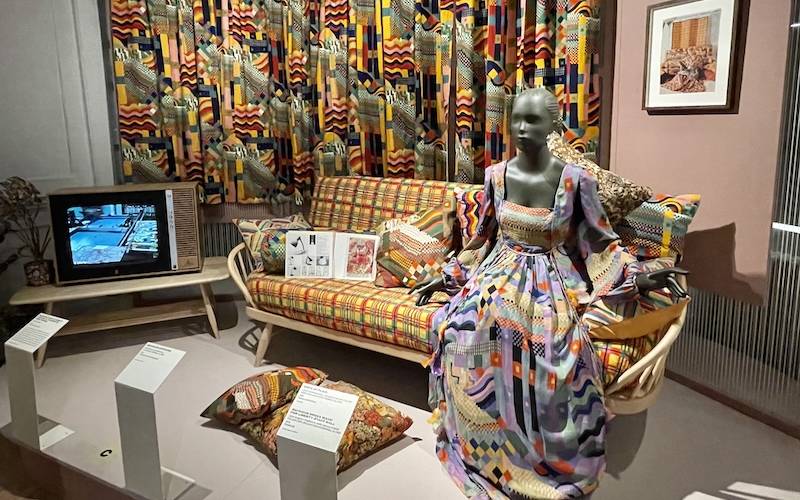
When I headed off for my freshman year at Davidson College, I did not know I would be sleeping on sheets that were part of a textile legacy begun in London in 1875 by Arthur Lasenby Liberty.
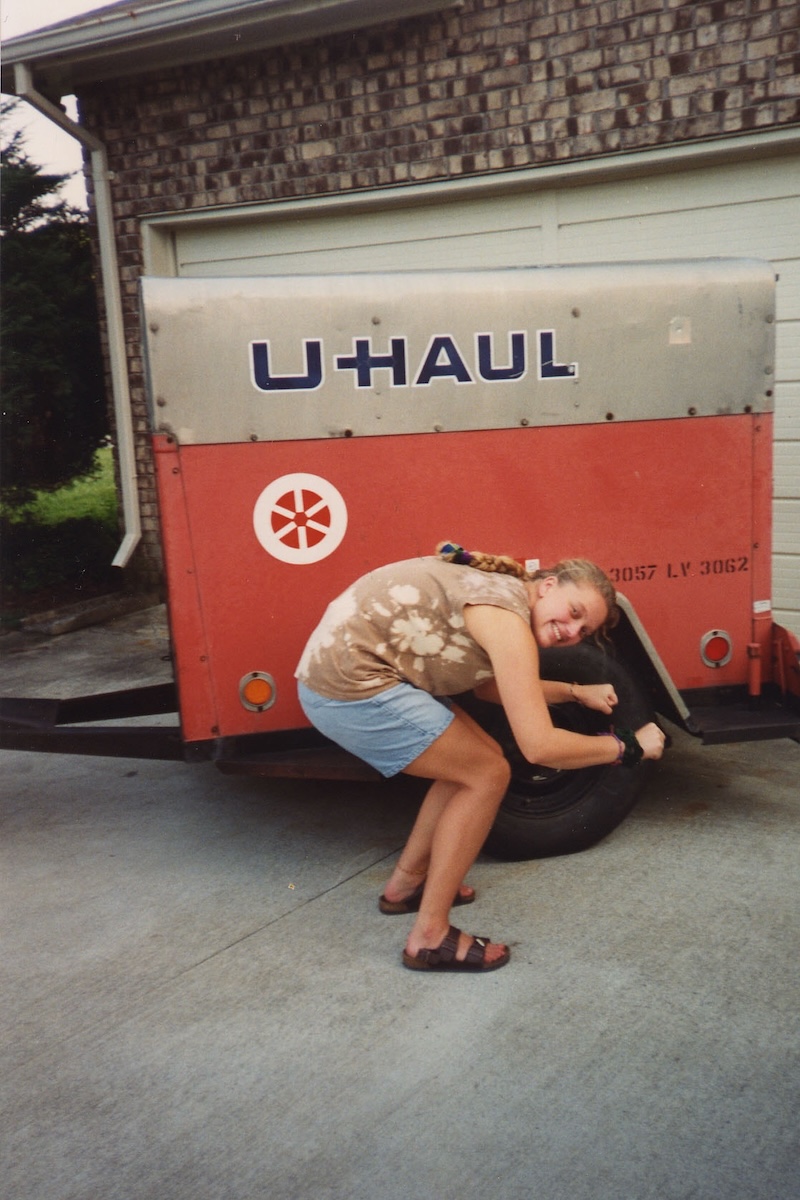
Who else took a small U-Haul to college with Collier Campbell safely packed inside? I think I was pretending to be the turtle carrying its own shell here.
Mom surprised me and went down to Dillard’s department store in Nashville. She bought the sweetest Collier and Campbell “Gypsy Dance” sheet set for my dorm room bunk bed and I still have offcuts of that fabric in my sewing room today.
Sisters Susan Collier and Sarah Campbell were two amongst the many women whose designs defined the look of Liberty from Victorian England right up to now.
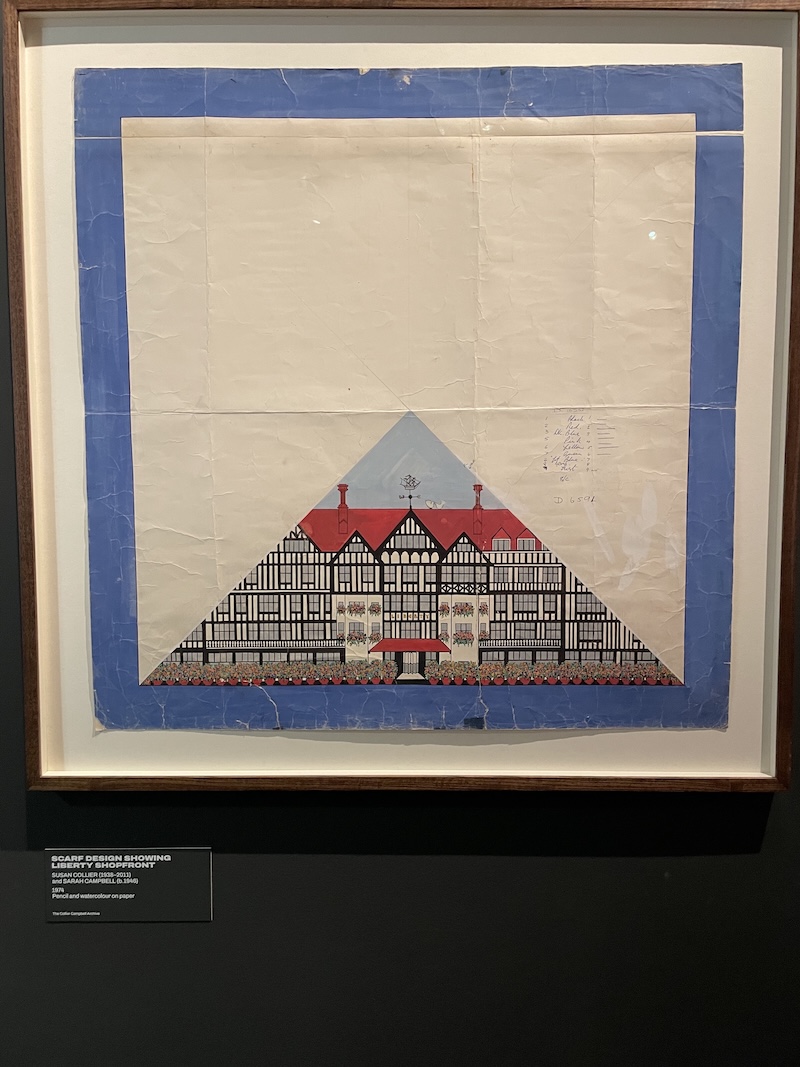
Collier and Campbell’s design for a scarf depicting Liberty’s iconic mock Tudor building in London. 1974, Pencil and watercolour on paper, The Collier Campbell Archive
You can see this delicious parade of color and pattern at the William Morris Gallery in Walthamstow, northeast London. “Women in Print: 150 Years of Liberty Textiles” takes you through two floors of designs by the women who’ve made Liberty of London an essential destination for textile enthusiasts the world over.
Let’s start with Collier Campbell because there’s a whole room devoted to these exceptional sisters. A few samples of their work are in the header image.
Sarah Campbell says that she and her sister loved the challenge of getting a free-flowing design into a repeat pattern, so that the wearer or decorator hardly knew it was a repeat. Susan Collier was Liberty’s Design and Color Consultant from 1971 to 1978. Together with her sister Sarah, they created some of Liberty’s best-loved designs.
Working with Liberty catapulted the sister’s careers, which is how their designs ended up in Dillard’s in Nashville and on my college bunk bed twenty years later.
But not all Liberty designers were well known.
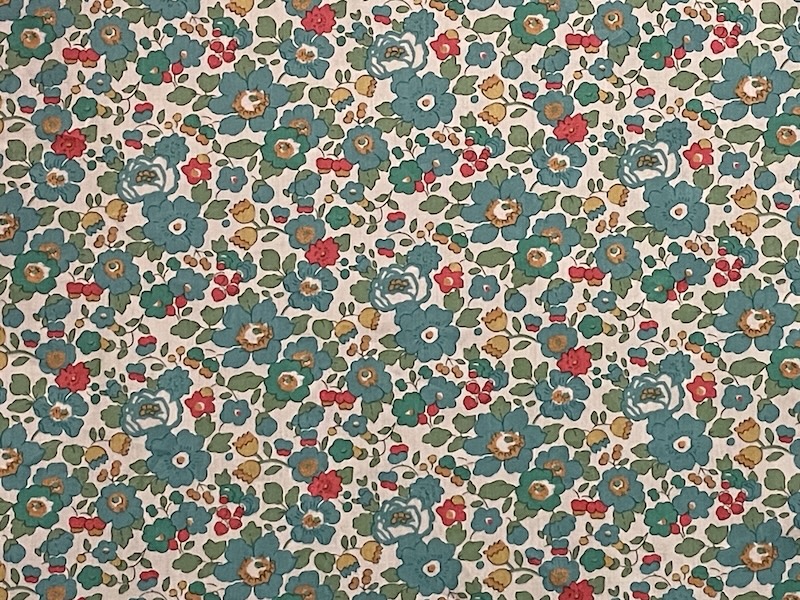
“Betsy.” D. Stoneley. 1933. Liberty Fabrics Archive.
Take, for instance, the mysterious D. Stoneley, also known as D.S. and Mrs. Stoneley in Liberty’s pattern books. Nothing is known about her except her designs. Everything about her life is lost to history—but in the 1930s she created some of Liberty’s most iconic designs, many of which are still in production today like “Betsy.”

Unknown maker; fabric designed by MADELEINE LAWRENCE (1896-1952), C.1935. Printed linen. John Bright Collection.
By the 1930s nearly half of Britain’s textile designers were women, but that doesn’t necessarily mean they were well paid, even at Liberty. Liberty bought designs from the Silver Studio and Madeline Lawrence, who designed this print, earned under £2 for a 48-hour week, less than the wage of a shop assistant. A single yard of Liberty’s printed cotton cost more than half a day’s wages for a female Silver Studio designer.
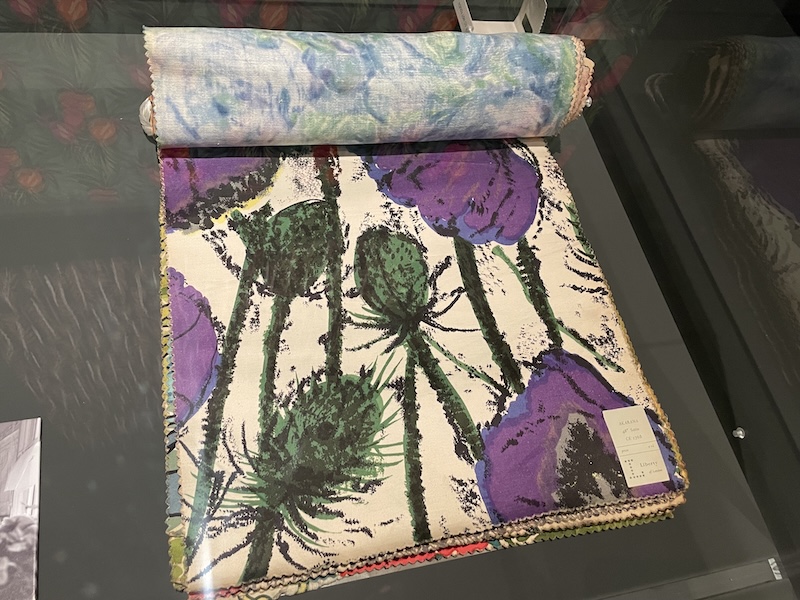
AKARANA IN LIBERTY SAMPLE BOOK. ALTHEA MCNISH (1924-2020). 1961. Screen-printed cotton and card. Liberty Fabrics Archive.
Thankfully, attitudes and wages changed as women demanded more equity in the workplace. Liberty became a magnet for women at the forefront of creative design. Take Althea McNish.
McNish’s abstract floral forms and tropical palette were inspired by her upbringing in Trinidad. Her bold, vibrant patterns appealed to Liberty’s 1960s buyers, who were seeking fresh designs to attract post-war customers with a taste for color and modernity. McNish went on to create over 60 silk scarves, dress and furnishing fabrics for Liberty.
Another 1960s designer whose work captured my heart was Jacqueline Groag.
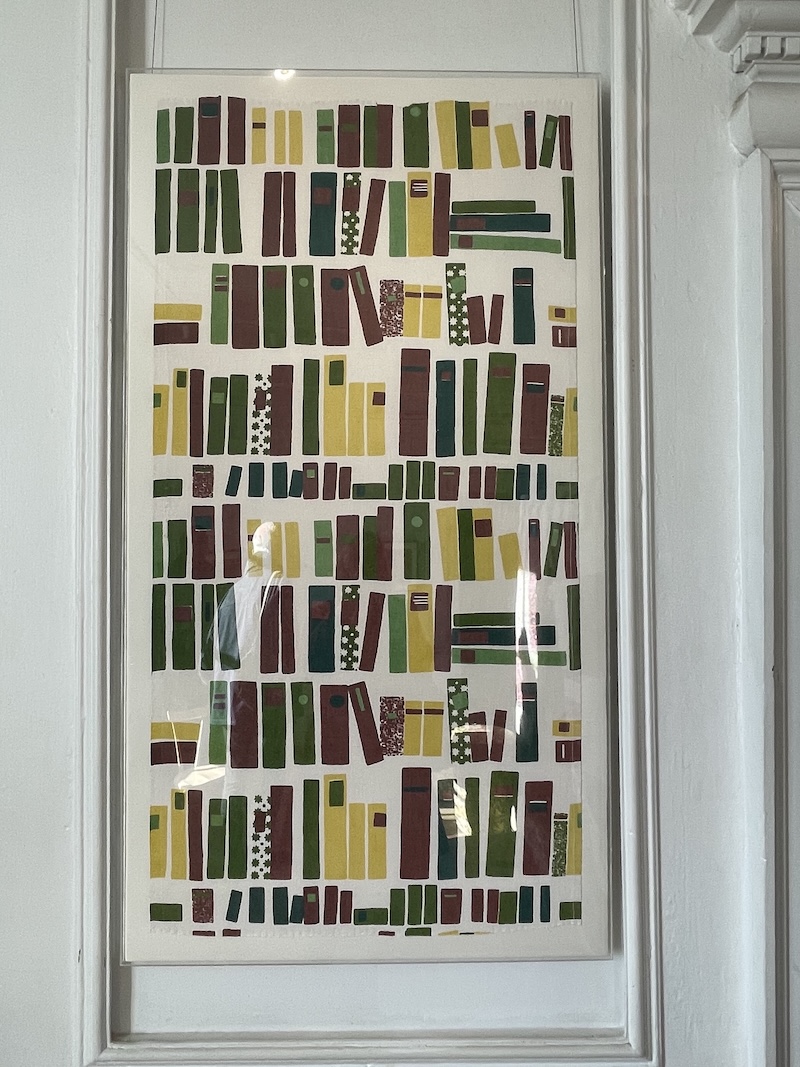
BOOKS. JACQUELINE GROAG (1903-86). 1954. Screen-printed linen furnishing. Collection of Meg Andrews.
Groag and her husband escaped Nazi Germany and, after settling in Britain, they became hugely influential in the British design scene. I want her book fabric in a skirt, on my bed, for curtains, and a table cloth. Book fabric everywhere, please!
With literally dozens of designers featured and hundreds more in the wings, my article can only tempt you to make a trip to London and see for yourself. The exhibition lasts through June 21, 2026, so there’s time to make a plan.
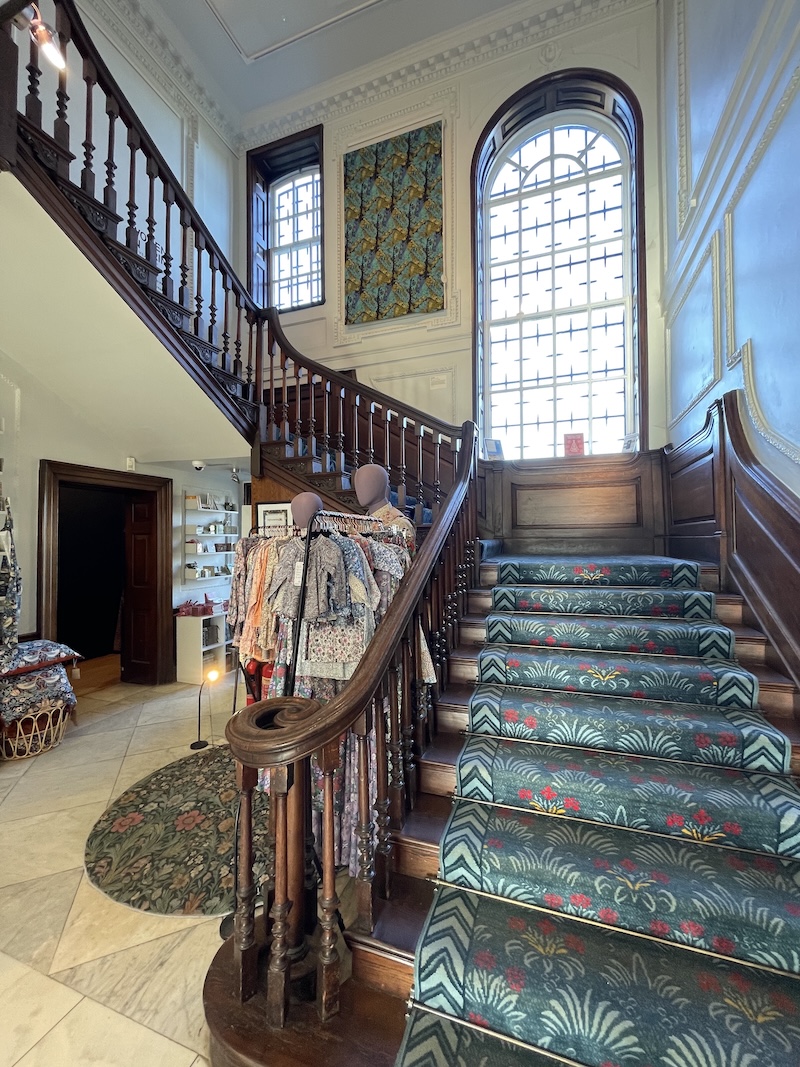
A view of the sweeping staircase in the William Morris Gallery.
The William Morris Gallery itself is a treat because. Liberty’s designers, with their leaning toward floral and naturally inspired patterns, embodied many of the values that Morris espoused in his work and writing: “‘I think it will be enough for us to clothe our daily and domestic walls with ornament that reminds us of the outward face of the earth.”
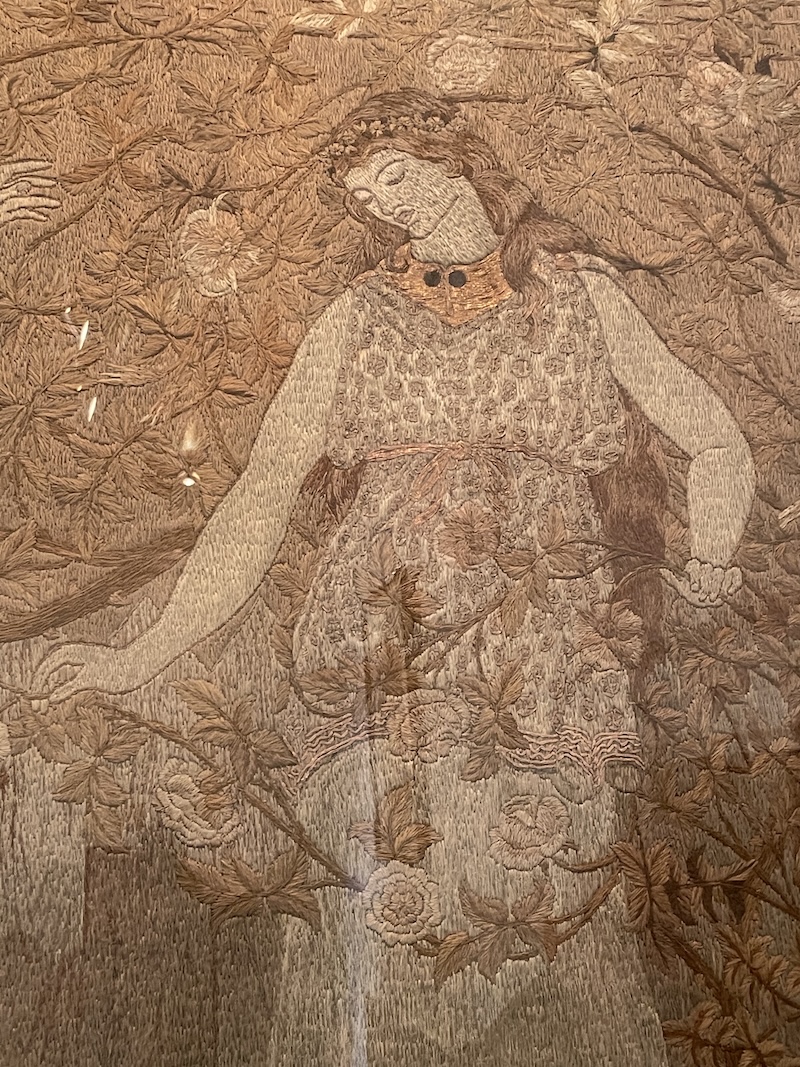
“The Pilgrim Finds Love.” the final panel of a large embroidered frieze for the dining room at Rounton Grange (a house now demolished). Wool, silk, and gold thread. William Morris Gallery via Hugh Bell and the V&A.
There are several gorgeous permanent exhibition rooms dedicated to William Morris’s illustration and textile designs.
The walk from Walthamstow station to the William Morris Gallery takes you along a typical London high street replete with cafes. The Gallery has a popular and busy cafe. The gallery is also a house where William Morris once lived and is set in a huge park so you can take a fine walk to muse on all of the delicious print and color.

A perfect pattern for winter evenings. Dark Garden by Manchester-based designer Hilda Durkin. 1953. Screen-printed linen. William Morris Gallery Archive.
Across the street from the gallery, there’s a Salvation Army shop where I found a pristine set of 1930s double pointed knitting needles still in their packet and an uncut wartime child’s coat sewing pattern. So, it’s well worth a look!

I used to make Liberty the joyful part of any visit to London in the 1980s. I bought fabric, and complete sewing kits to make skirts and tops, and just breathed in the beauty. It was like an extension of the V&A, only you could buy stuff! The building itself is gorgeous, of course. I took my eldest there last year, which was a disappointment. So much less product, nearly empty galleries, and the haberdashery, that used to be huge, busy and smelled wonderful, was now a single sparsely supplied room. The best thing there was the dear Morgan Freeman lookalike showing the ladies how the fancy hand washing thing worked in the ladies loos! I shall be visiting the museum instead. Happy Christmas and New Year to you!
Again, Jeni, so interesting. Another iconic entity owing its success to underpaid anonymous women (Hidden Figures, et al). And lucky you, spending your college days on sheets that almost feel like silk. In 2006 Liberty moved from their lavish location on Regent Street to …someplace else. I was afraid to investigate further for fear it would be something too “down-sized” or “modern.” As probably a more commensurate, if temporary, replacement the stunning William Morris Gallery is very, very satisfying. Thanks for that picture.
HI Chloe and Susan, too! Liberty is still on Regent Street. I live in London and go there often. They did have some building works so maybe they moved things temporarily in 2006? Yikes, I don’t know. But they’re there in the iconic mock Tudor building as always. I do, however, have a similar feeling to Susan which is that the haberdashery department isn’t the bustling and overflowing wonder that it once was. There are only two rooms now compared to what I remember as four at one point. There’s one room full of the iconic Liberty fabrics and the other room has a selection of Merchant and Mills sewing supplies and patterns, a bit of wool, needlepoint kits, and Liberty fabric sewing kits. So, it’s not a great location to pick up sewing supplies anymore. I definitely recommend MacCulloch and Wallis (a five minute walk from Liberty) for all kinds of notions, fixings, as well as yarn, needles, and gorgeous fabrics of other types. They also have a lot of millinery supplies! Liberty is definitely still there for your Liberty fabric and they are bringing out prints by new designers and collaborators each year, but it’s certainly not the complete sewing destination it once was. One neat thing is that they recently re-launched Sarah Campbell’s original “Cottage Garden” design this past fall.
Fun fact, if you’re ever in Lancaster up in the northwest of England, Standfast and Barracks has a factory shop up there with seconds and slight misprints, etc. They print a lot of Liberty fabric (as well as some of the prints from Charleston House — Vanessa Bell, Duncan Grant) and you can get some Liberty fabric for a steal!
Oh thank you so much about the info on MacCulloch and Wallis! When I visited Liberty in 2024, I was also a bit sad–I couldn’t find a single bit of fabric I wanted to buy! I’d not heard of the William Morris Gallery, so adding that also to my “Travel note to Self” (filed in my Travel-UK Notes folder on my computer LOL so I don’t lose the paper). ENJOY those visits! My first time was as a student in 1978, and have been back a few times. Wish finances allowed me to just pop over for the exhibit, but since they don’t thanks so much for the visit!
Susan just confirmed my fears.
Thank you so much for this article Jeni! I adore Liberty and we visit at least once every time we are in London. I purchased a Liberty advent calendar last month and am loving seeing a different print each day. They really are timeless.
My best wishes to everyone at MDK for a well-deserved and happy holiday!
I have loved all things William Morris for a very long time. Visited Walthamstow (last stop on the Victoria Line) about 10 years ago and spent many happy hours at the Gallery. At that time, Debbie Bliss had a shop in Walthamstow which we also visited and she was very welcoming and happy to chat about her design process. One of my most favorite memories from more than a dozen visits to England.
OH, wow! I would have loved to have gone to a Debbie Bliss shop! How great that you’ve been to the gallery!
Such beautiful fabrics! Thank you.
I would love to visit, but pictures are the next best thing. I finally figured out how to fix my sewing machine last week. I feel a Liberty rabbit hole coming on…
Oh! I’m so excited that your sewing machine is up and running! Enjoy!
This makes me want to book a flight to London just to see this!
Wonderful! No current trip to London planned, but this is surely a motivator. The Liberty store is the only “must do” for me when I am in that bustling city. Thanks for all the background. And, I am married to a Davidson grad, so I appreciate your keen mind!
Hi five to your Davidson grad! If you love visiting Liberty, I was saying above to Chloe and Susan, you’d probably love going to MacCulloch and Wallis as well which is only five minutes away. It’s my go-to place for sewing supplies, yarn, needles, etc, in London and they have some exceptional fabric there, too.
If I could afford Tana Lawn it would be my entire wardrobe.
On this side of the pond, Morris designs are suddenly everywhere … and there is some lovely affordable fabric available. Not Liberty, but it’s earlier influencer as we’d say.
I’m with you, Gail! Head to toe Liberty is a beautiful dream!
p.s. – I love how the fabric floor at Liberty has couches for your partner to sit while you run your hands and eyes over the fabric.
And my friends and I miss the ‘year’ mugs they used to make … if someone went over the pond that is what we wanted them to bring us back.
Every one of your articles has me wanting to buy a plane ticket! Liberty and William Morris together. Sigh.
That’s such a great compliment! Thank you!
A very interesting article! Thank you!
Doggone it, now I’ve got the dilemma of absolutely needing to visit London twice in quick succession, because the Liberty exhibit and the Bayeaux Tapestry visit to the British Museum don’t overlap. Oh London, you temptress.
I lived in London for 6 years before I came to the US many years ago. I loved the Liberty store and bought fabric there when I could afford it. (Not very often). I made a cute outfit of top and shorts and hitchhiked around Europe in it in 1970?! I wonder what happened to it. I can still picture the lovely fabric. I wonder if they still make it?
Lovely! I wish we were going to be in London to see this in person, but thank you, Jeni, for your report!
Besides the scarf, is there a picture of the Collier Campbell fabric? I don’t have any experience with it so nothing comes to mind.
I am visiting my daughter in London in April, so will get to see the exhibit. I’ve been to the Dovecot studios in Edinburgh, but the museum looks spectacular.
The top photo of the mannequin in the mock living room is all Collier and Campbell fabric including the mannequin’s dress. A Google search will bring up lots of their designs down through time but Sarah Campbell is still designing fabric and has a website under her name (her sister Susan Collier passed away several years ago). She’s also a wonderful teacher and frequently gives workshops in and around London and I highly recommend them!
Jeni you are so talented at giving us this history!!! My aunt who was a nurse during WWII and then stayed for a few years in London gifted me a lovely smocked dress from a beautiful Liberty print in the early 50s. Very similar to “Betsy”. It was cherished and recently passed to my granddaughter.
Do any of your dolls dress in Liberty prints?
Deneise
I love the story of your smocked dress so much! What a wonderful treasure to be able to pass down. I love that you asked about my dolls being dressed in Liberty. I don’t have any dressed in Liberty, but I do intend to! I have to admit to being a bit of a fabric saver, but I’m slowly transitioning to a fabric user. I am going to stop “saving my fabric for good” as we say in Appalachia and just enjoy it. So the smaller cuts of Liberty fabric shall go to the dolls and then patchwork and the larger length shall go to simple skirts for me!
Oh, how I’ve missed that expression: “saving _______ for ‘good'”!
Thank you, Jeni! Even though I no longer sew, knowing Liberty is still there does my heart good. My visit was especially dear to me because it was while exploring there that I first experienced the deep fatigue that turned out to be the harbinger of my first pregnancy. I could barely stay awake on the bus up Regent Street to my hotel to meet my husband back from his own adventures, then fell immediately to sleep. But, now I know that if I am ever lucky enough to visit London again, that I can safely make my way back to Regent Street and still find Liberty.
Oh yes, Liberty of London and the Victoria and Albert Museum are top of my list when visiting London. I will now add the Salvation Army store to that list!
Thanks!
Fabulous article, Jeni, as always. And I’m excited that this show lasts through June as I’ll be in London in May. Maybe I can actually see it! And that embroidery is amazing….thank you so much for sharing all this.
Marvelous feature on the “Women in Print” exhibition at the William Morris Gallery! Thank you for sharing images of these timeless textile designs.
The MFA, Boston’s upcoming exhibition “Framing Nature: Gardens and Imagination” (March 15-June 28, 2026) publication will feature John Dearle’s “Greenery” tapestry woven at Morris & Co. and May Morris’s embroidered portieres commissioned by Mrs. J. Monro Longyear in the same year.
https://www.mfa.org/exhibition/framing-nature-gardens-and-imagination
We need to charter a fleet of planes to take a class trip!