
How To
Me Versus the Short Rows
Hi everybody,
Kay here, reporting live from our Bang Out a Sweater knitalong.
It’s Day 12, deep in our second week. Those of us who are taking the workshop have been braced by a three-hour session with the brilliant Lorilee Beltman in which we swatched, practiced, and generally got our feet under us.
We have also faced our first battle: the eight short rows that will make the back of the neck sit higher than the front of the neck opening when we wear our Waffle Pullovers at the end of the month—and we will wear them, by cracky!
Plain Speaking about Short Rows
Short rows are not fun. Well maybe they are fun for somebody out there, but not for me. It’s taken me a long time to have a working understanding of why we are doing these short rows, so I thought I’d share that.
Visualize a favorite sweater. When you lay that sweater flat, with the front of the sweater facing up, take a look at the neck.
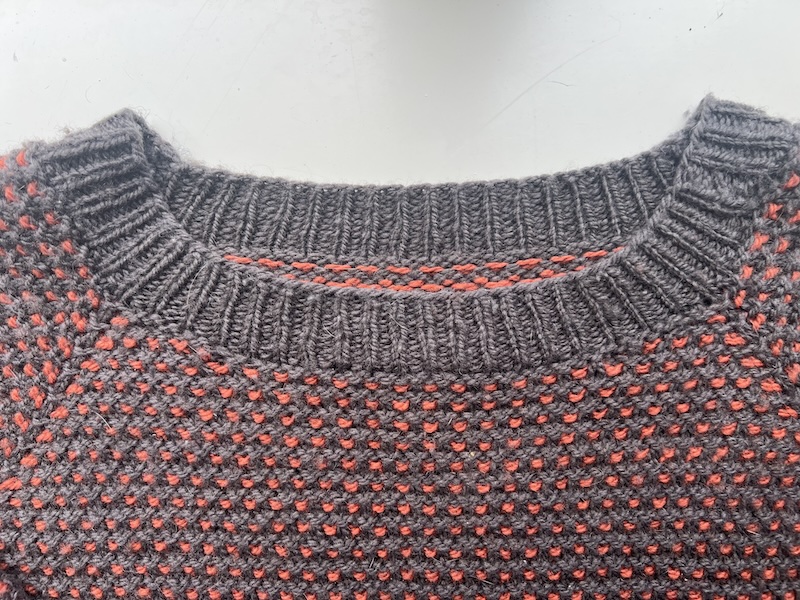
See how the back of the sweater is slightly higher than the front neckline? There is a little more fabric back there, even with a crew neck like the Waffle Pullover’s, which sits fairly high. With a scoop neck, you’d see even more fabric at the back compared to the front.
If you knit your sweater’s back and front in separate pieces, as we did in the olden times aka the 1990s, it’s easy to make the back neck sit higher than the front neck. The pattern just tells you to do more knitting on the back before binding off for the neck opening. Then, when you knit the front piece of the sweater, the pattern tells you to bind off earlier for the neck. You don’t even think about it. It’s the way sweaters knit in pieces work.
When you knit a sweater in the round, from the top-down, getting more fabric in the back of the neck than in the front of the neck is not as obvious. Some in-the-round sweaters don’t bother with this at all: you get a sweater neck that is the same height in front and back.
Easy to work! But it leads to a fit that some feel is less than ideal: if the front is low enough for comfort and the desired style, the back of the neck feels kind of naked, and if the back of the neck is fully covered, the front of the neck may ride too high.
Some clever person thought of short rows as the solution. At the beginning of the sweater, after knitting the neckband in the round, you work a few rows back and forth—flat—to add that extra fabric to the back.
While the concept is simple, it demands focused attention from the knitter. You have to count stitches to place these rows in the right place, you have to follow a method for preventing holes at the points where you turn, and you usually have to alter the way you work the sweater’s stitch pattern, since even the humble stockinette stitch is worked differently back-and-forth than it is worked in the round.
It’s a lot. In the two-color version of the Waffle Pullover, you also have to change colors, right in the middle of the row!
I usually have to make at least two attempts at the short rows to get them right. I accept this as my fate. It’s frustrating, because the short rows happen so early in the sweater, before you get to The Fun Part, where you get your confidence going.
But when you’ve conquered the short rows, it feels really good. You can start to feel smug about the fact that you are not going to have to seam this sweater.
This time, my first attempt at the Waffle Pullover’s short rows was unsuccessful. I ended up with my stitch count off by 2, even though (1) I am smart, ok? and (2) this is my second Waffle Pullover. I did not just fall off the waffle truck, but to err is human. The do-over slowed me down by a few hours, but it did not break my spirit.
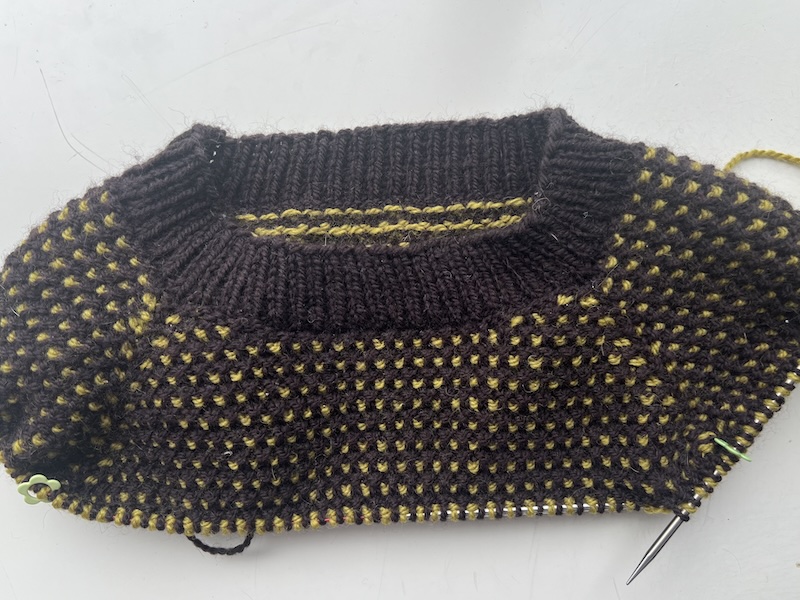
Here’s where I was as of yesterday afternoon.
I’m trying to get through the rest of the yoke shaping before tomorrow, the next session of our virtual workshop with Lorilee, but: it’s a lot of stitches. I’ll get there or I won’t, and that’s what the class recording is for!
Tips on Short Row Success
- Work the short rows all in one sitting, in good light, at a time of day when you are the most hopeful, focused and resilient, when the dog has been walked and your housemates have been requested to leave you alone.
- Be nice to yourself. Hydrate. Self-affirm. Negative self-talk never got any short rows done.
- Have faith in the pattern’s instructions. They are correct.
- Remember that every bit of the instructions matters. The brackets matter. The asterisks matter. The word “turn” matters.
- Phone a friend. If there is a part that you don’t understand, seek help from a fellow knitter or from us. We all get that this is not easy. Every knitter needs help, or a second opinion, sometimes.
- Eyes on the prize: look forward to the hours of easier knitting that begin immediately after the short rows are complete, and the truly easy, dare-I-say boring knitting that will happen after dividing the sleeves and body. You’ve got some TV knitting to look forward to!
Banger-Outers, let me know: how did the short rows go for you? Are you ok? Can I interest you in a Belvita?

It took me 4 goes to get the short rows section right! But I had the same feelings as you, Kay, when accomplished – I felt very smug indeed! I must say that I’m so glad I was able to watch Lorilee’s video session on the short rows, it really helped a lot.
Love these tips! Short rows give such a good shape, but they’re far from simple. Thank you for letting me know I’m not alone in my panic!
I, too, struggle with short rows. I made the waffle pullover in the fall, and had to do the short rows 3-4 times to get it right. I was beginning to worry that I would wear out the yarn before even getting started, but good wool holds up well.
If *Belvita* is a code word for a very large glass of wine, then yes please.
Looking a frog and redo. In Navy. All Navy. Why????? It’s so hard to see what’s going on.
I’ll have a “Belvita” with you!
Kay – your tips are spot on. And your color choice is excellent!
Thanks, Kay! Your pep talk came right when I needed it! When Lorilee said in class that this part was like patting your head and rubbing your stomach at the same time, she described my feeling perfectly. Watching the recording many times has really helped. Amy’s comments on Ravelry added some perspective. But, your comments today were the icing on the cake. Every mistake I make helps me understand better!
I love the yarn. Jane is special to me. The ” year of the swatch” phenomenon that proceeded our project was ( is) an unexpected treat. I’m determined to master this part because I really want to make more than one. But right now, I’m still in labor ( sigh) with the first one!!!!
Thank you for sharing your journey, Kay. I think it really helped! I won’t be knitting the Waffle pattern for several tricky reasons but I think you have primed me for the next time I encounter a short-row sweater and I will be more likely to dive in. (Somewhere out there I remember seeing a pattern that had a substitution for short rows but I sadly can’t remember it and it may not have worked for all patterns.)
Is it too late to sign up for the virtual class? I’m not signed up as I’m not banging this February because: 1). Downsizing/ moving from large house to small apartment on on the 22nd; 2). children and grandchildren arriving tonight from 3 different states for one last hurrah/party/help packing/take home what they want from the family home, etc. So we’ll be feeding and housing 16 this long cold weekend!!!
And 3). Winter Olympics are taking every free moment I have…can’t focus on a sweater when exciting competition is on, only sock knitting will do. (And 8 out of the 9 grandchildren like hand knit socks, so that’s good.)
But I’d like to bang out a waffle in April or May when things settle down a bit…..so if I can still sign up and watch the recorded workshops THEN, I’d like to!
Hi Barbara! Not too late! Sign up now, and you’ll receive video links of all three sessions, which will remain available to you indefinitely. https://www.moderndailyknitting.com/shop/bang-out-a-sweater-virtual-workshop-with-lorilee-beltman/
It took me two attempts to get through the short rows and on the second try, I used markers to identify the double stitch easily. I have done German short rows before and once the concept was in my head and I could see where the DS was when I knit or purled to it, they are definitely easier to work with than the “normal” short rows and no fiddling bringing up the wrap onto the needle. Patience and perseverance wins out.
Frustrating is one word I would use for the short rows in the waffle sweater, it took me 3 tries but I finally came out with the right stitch count. I certainly mastered ripping out the knitted short rows before I finally got it! It was worth it, I know I’m going to love this sweater. I too am hoping to get to the sleeve divide by class time tomorrow but it might not happen and so what? I am enjoying the process and am so glad I took the plunge and signed up for the class, thank you for offering it.
It took me two attempts to get the short rows right but I am happy with the results!
Wendy! You have no idea how much better this makes me feel.
I am to the first sleeve of my sweater — I started it ages ago and then abandoned it for no good reason.
And I will confirm both the short rows and the yoke shaping nearly drove me to drink (but I do NOT advise drinking during this first part!) and I restarted twice before I got it going correctly only to find a stretch of stockinette that should have been purl.
I fixed that with a duplicate stitch dupe and it has been smooth sailing since.
Even the sleeve shaping is easy after that!
The fun mosaic and the squishy yarn make it all worth it!
I too had one redo on the short row, but have finally gotten them right. To your list of instructions I would add one more to paraphrase Elizabeth Zimmerman (she added this upon finishing a steek): Go lie down in a darkened room with a cool cloth on your head.
I also had to frog the short rows and start again, but this time I got it right and now am into shaping the yoke.
Someone in MDK Society made drawing for me that was worth the price of admission!!!
I am in short row hell with another pattern, it is currently in a time out. Thank you for the tips, especially to do it all in one go. Have faith, trust the process. Very helpful indeed!
You are absolutely right on how to “tackle “ short rows! I tell people to do it when you are fresh in good light with NO distractions. AND, do them all in one sitting.
I needed to unknit a bit, sigh… I have a housemate that thinks that the request of “please don’t bother me for a bit” was a suggestion… yes, they are still alive.
But the second… alone in the house attempt went much better!
And I am feeling all sorts of wonder and awe for the brilliance of Amy C’s mind as well as quite accomplished myself!
I have finally knit one sweater where I got the short rows correct (because 99 start overs). Now, I want to tackle how to do “more” short rows to accommodate the dowager’s hump I’ve earned like the wrinkles…gravity being a thing. I am seeing sweater sleeve caps started with short rows. Is there an encyclopedia of short rows somewhere out there? I clearly don’t think like an engineer, alas. But I bring a high degree of stubborn determination.
Thank you, Kay! Completing all the short rows in one session, relying on good light, and finding the rhythm, helped very much. At one point I thought I was going off the rails, but I wasn’t. Remember when you asked us to take a screenshot of Lorilee’s swirly drawing of short rows turning back and forth, the swirls growing longer with each pass? I printed my screenshot, and had it there to remind me of what I was creating. My finished result seems to be correct, fits perfectly, and looks very nice!
I did the short row section in one try and got the correct number of stitches ….
Yay me ! But I don’t love doing the German short rows and wonder what is the main difference from wrap and turn ???? I’m not mistake free though because I have a
“Little “ jog in my nice straight seam stitch which is going to be corrected with one duplicate stitch. I know what the mistake was but living with it. Onward !
It’s very encouraging for me. I usually avoid a pattern that has short rows.
My sweater is literally on hold while I participate in Finish in February with my local yarn store. The good news is after finishing some melt in the ice hats. I am finally putting the i-cord binding on my Savage Heart Cardigan. Good things come to those who wait.
It’s wonderful that you’re making Melt the Ice hats! Thank you! I’ve made one and working on a second .
And besides all the wonderful and helpful Korilee and Kay tips, I found one of my own: I found if I slipped a removable stitch marker through both legs of the double stitch, I was never in any doubt about where it was when I came back around.
I do this, too.
Oops! Lorilee, not Korilee!
Third time the charm for me! I too initially marked the DS but then began to see them clearly. Much learning in this project
I started a different sweater in January and I am a few days from finishing it but decided to start the Waffle. I have restarted the short rows several time to get it right. All Kay’s tips are very helpful so I have decided my biggest issue is wrong yarn (not Jane, but a tweedy one), and maybe wrong needles and then a little tendonitis to boot (blaming that yarn).
So I will have a February sweater, just a different one. Besides seeing all the fun color combos makes me rethink what colors to use.
Please stay tuned for an upcoming episode, “False Confidence, or, Where To Put The Lifeline In Row 6.”
Interesting solution, but sometimes this is why I prefer sweaters in pieces. Seams have a purpose. Especially sleeves – I hate flopping an entire sweater in my lap to knit sleeves. And I’m not afraid of sewing seams.
In other things – you got a new dog?
Aww …
I really prefer top down sweaters so I can try them on while knitting and adjust the length, which is usually different from the pattern. This allows me to stop knitting the body and do the sleeves. Then I know how much yarn I have to add length. Because of that, I won’t do a sweater that isn’t top down in the round.
Totally agree. Plus, sweaters knit from the top down invariably stretch at the neck and shoulders no matter what I do.
That hasn’t been my experience but I do miss knitting sweaters in pieces—such portable knitting!
Thank you so very much for this. I’m so frustrated and have to start over yet again. Today! Like class is tomorrow and I don’t have my homework done! I really want this sweater. In my vision for completion it is flawless and a thing of beauty in my reality- it’s looking a little like a plate of cooked spaghetti.
Had to take out my first short row rounds. I will persist! Kay’s tips are very helpful and I will incorporate them in my next attempt!
I struggled with short rows until I read a tip (not sure where) that seems to help. When you make your double stitch and pull it up, put a lightbulb marker through both loops. Now you can see easily see where that DS is. I leave it in when I work it, at least for a bit, then remove it when I am sure that it is right. you can leave them all in and remove at once until you get used to it. it’s just a little visual clue that seems to help.
As always,Kay, great advice for your fellow knitters!
You go, Kay ! I think a 2-colour short row section would break my brain. A learning opportunity !
My second sweater and I think I’ve spent at least 5 hours trying to get the short rows right…thank goodness the yarn holds up to the constant frogging. I simply decided the yarn and pattern are not the boss of me
Thanks for sharing this! I just had to rip back my short rows as well and thought what the hell? I will start again today
The heading for this part of the pattern should say Shape Back Neck/What the Hell?
It is always good to know I am not the only one. EVERY SINGLE sweater, I struggle with the short rows. Thanks for the tips!
Just like in life, I tend to assume that everybody else is having an easier time, and I’m always wrong about that.
Just the most difficult knitting I’ve ever done, but Aimee’s help and rewatching the videos, taking notes, and persevering have me racing to get ready for tomorrow. It’s not perfect, but perhaps my second Waffle Pullover will be closer to perfect! Thanks for all the support…
This is my second waffle sweater and I got the short rows on the first try each time. This isn’t my first try at short rows, though, and I’m sure it was a struggle before. Having said that, I didn’t really understand them until Lorilee did her “on the spot” diagram of what we were doing. I now have a much better understanding of how short rows actually work and why we changed colors in the middle of the row. Thank you Lorilee!
I kind of like short rows. They are fascinating. The things they do! The things you can make with them! Embrace the short rows!
Joining in on the confessions, I will begin my 4th start of the short rows this morning, calm, in good light, and with a clear head (I hope). I will not stop until I finish (or, again, end up in Error Island). I am getting better at un-knitting short rows….
Just finished a set of German short rows on a Knitting for Olive pullover and feel like a magician. But there for a while the sweater bristled with stitch markers. Am I the only one who can’t tell a w&t or a ds without visual clues??
My DS somehow kept looking like a wrap and turn. I ended up using a removable marker to hold both parts of the DS too. It made the difference between trying to figure how how that was a double stitch and just knitting or purling it! And I don’t really know how many times I ripped back. Let’s just say the pain is gone now that the sweater is moving along!
I always use markers. I feel like the instructions should include placing markers. They are so helpful, especially with low light or low vision.
This! Even though I use German Short Rows (which IMO are easier) it still takes focus. I usually knit 2 rows max and then take a break because if you make a mistake there is no going back. Thanks for saying out loud what we are all thinking
I agree to re-naming the section Shape back neck/What the hell.
I’ve ripped back to cast on twice now in frustration.
Short row has change to color B, sl1wyib, M1R. Is the slipped stitch color B and how can that be? If the M1R is color B, how do we do that if the horizontal bar is color A? I really, really wish this had been demonstrated in the first video.
This is my first sweater and first experience with short rows. Trying very hard to not give up on this.
You are correct in SO many ways… trust in Amy’s directions. She will lead you to success!
I just separated for sleeves and body. The pattern, A for 2 rows (K a round, P a round) then B for the 2 row Slip Stitch pattern is feeling engrained in my head.
Gonna go watch some Olympics and have myself a marathon of body knitting!!
What a helpful, understanding, and sensitive post for those of us who find a pattern we love and then see that it calls for short rows, and almost decide to not knit it.
But, I will treasure this post and always bring it out when the short row challenge presents itself!!
Thank you.
Last weekend I set aside a whole afternoon to tackle the short rows. I got all the way through it, and a few rows later I realized something didn’t look quite right. It turned out that I messed up on where I placed the stitch markers BEFORE I even got started on the short rows, so I had to rip it all out and start over.
Oh that’s unfair! An error somewhere else when you got the short rows right on the first go!
I have a dear knitting friend who gave me the best advice when I started knitting many years ago. Just cast on. The pattern will take you from there. This pattern is so well written, I got through the short rows just fine. Quiet time was the key. The increases are seeming endless right know… but very doable watching the Olympics.
I was very glad I had put in a lifeline after finishing the collar and before starting the short rows, since my first attemp was a failure. I rewatched the video and then made my own diagram as I knit the short rows so I knew where I was and what direction I was going (I’m mmouse15 in the Lounge), and I made it through on my second attempt. I definitely was alone, had no distractions, good light, and finally made it through with the correct stitch count. Holy smokes, I felt like I’d run a marathon, though!
I agree with Bonnie, embrace the short rows! They are just devices for shaping and/or messing around with colors. A fun read though, Kay. Thank you!
Hi! I’m encouraged to hear that you also had issues.
I too am pretty smart, and I’ve knit dozens of sweaters, and I watched the first class. Given all that, it was fairly discouraging when my first attempt at the short rows came out wonky.
After desperately considering possible fixes, including hiding errors with duplicate stitch(!) I had to concede that due to the very graphic nature of the pattern, fudging would not be possible. A little real talk with myself resulted in me ripping my work back to the ribbing, and doing it over. It was successful the second time, but then I confronted the instructions for the yoke shaping, and was flummoxed once again.
Many thanks to Aimee from MDK, who explained the instructions and sent me down the right path.
I feel that much of the issue is in the way the pattern is presented. A few more words of explanation would help for those of us who tend to overthink.
I haven’t started the short rows yet and am dreading them. Not my favorite thing. Instead of being able to work on the sweater like I planned, I was rushed to the hospital and had major abdominal surgery. There went my knitting plans. I however did rewatch the first session of the waffle sweater. So hopefully I can do it today before class tomorrow. It’s a lot to do, keep track of and remember. But even with that thought I have throughly loved this class. Lorliee is an amazing instructor. I am about dumb as mud on a computer so zoom was a bit difficult but got it to work. Never figured out the chat thing so just quietly tried to follow along and just pay attention and listen. Thank you so much for being able to replay the class. I will be at class tomorrow even if homework not done. I am 77 years old and decided a while back that I needed and really wanted to learn new things and learn to be a better knitter. Since becoming a widow there is no excuse not to keep on learning unless my brain goes too. Thank you for your wonderful classes and help when I’ve needed it.
You are on the right track Susan! Hope you are recovering quickly. It takes a while to get the hang of knitting and not to mention the Zoom technology on top of that. Once you get it though there are so many benefits to your health (and your brain). And at the end you have something lovely to wear or gift that you will treasure!
I would add, do not enjoy a nice glass of wine while doing short rows. Also, I find German short rows easier not to mess up.
Short rows? After seeing the written diagram Lorilee drew that clearly shows their layout and purpose it was easy! Getting the correct stitch counts in the different sections of the sweater while making the yoke and watching the Olympics? It took me a VERY long time to unknit a large part of the yoke. My count was off in every section and no section had the same count as any other section. I had a good laugh about that along with plenty of words that are considered “not safe for work”. I now count and document stitches in every section/row after completing an increase row and am hoping to do more knitting than unknitting for the rest of the sweater.
I spent a good chunk of time making myself a round x round checklist of the stitch counts for the part of the yoke where the increases are either just in the body or in all sections. Will it help? Who knows, but I am resolved to count my stitches after each increase round.
Thank you so much for your pep talk!! I have done short rows before, but this pattern is much more confusing. I am now, once again, back to short row 3. I don’t understand how to stay in pattern on that section. So tomorrow I will tune in and hope that Lorilee will address some of the issues with short rows. Her diagram was helpful, but I don’t think we spent enough time on the topic. Meanwhile, yay for all of you who have soldiered on!!
For years I avoided all patterns with short rows, I just didn’t get it. Instructions seemed baffling. Then I wanted to make an Emotional Support Chicken for a friend having surgery. This chicken is all short rows. Mistakes were made and frogs happened. Then in knitting group an expert friend showed me how to do it by the shadow method. Bless her. Henny the chicken cheered my friend greatly. She calls her the Love Chicken. I am brave enough now to try the waffle.
You might request your housemates to leave you alone, but they probably won’t if your housemates are humans under the age of 5 or felines.
Help! i am having a very difficult time trying to understand the short row directions I am doing something incorrectly or misreading the directions . Please help me!!! 🙁
Ha! It looks great Kay. I love your colors too❤️
I am going to make this sweater! I have the videos and need to decide on the colors of Jane that I want to use. I keep getting caught up with Earth. Is it a very dark brown
(Like earth?!!) or is it black?
I finally got through it after following two great suggestions from The Lounge: I enlarged the pattern instructions to a more readable size font and then marked each step off as suggested by Ann. Also got rid of all background noise, which was far more helpful than I wanted to admit
I draw it out on paper and indicate what colour per either end of the short rows. Then a put coloured stitch markers on the knitting so i know exactly what im doung when. This seems to help mr.
Short rows are not fun and need total concentration! I know this because I’m working on a sweater that has 56 short rows! Also, I’ve learned it is almost impossible to ripe out these rows and keep track of where you are in the pattern. The tips provided here are a great help!
My stitch count was 12 off.
Rip it, rip it, rip it
OK. It’s a class for me to learn!
I’m humbly beginning again. ☹️
I’m looking forward to knitting this sweater. I use short rows when I knit my socks but not in a sweater. We’ll see how that goes. It may take me two times or more Kay.